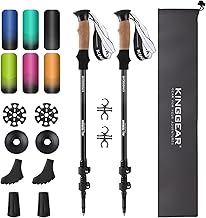
The best folding trekking poles for airline carry on in 2026 collapse to roughly 13–16 inches, weigh under 1 pound per pole, and fit diagonally inside a 22-inch international carry-on with room to spare. TSA explicitly prohibits trekking poles in the cabin under their sharp-objects policy, but in practice carry-on confiscation is rare when poles are folded, tip-protected, and stowed inside a closed backpack rather than clipped to the outside. The safest bet is a Z-fold aluminum or carbon pole with rubber tip caps installed, packed below your laptop sleeve. Below we break down the three packable poles worth buying for travel hikers, how to actually get them past the TSA checkpoint, and the carry-on dimensions that matter.
What makes a folding trekking pole airline-friendly
Top Picks
Quick comparison: best folding trekking poles for airline carry on
| Pole | Collapsed length | Weight (pair) | Material | Best for |
|---|---|---|---|---|
| TREKOLOGY Trek-Z Cork Grip | ~15 in | ~1.0 lb | 7075 Aluminum | Most travelers |
| Nordic Lightweight 7075 Aluminum | ~16 in | ~1.1 lb | 7075 Aluminum | Heavier loads, taller hikers |
| Collapsible Aluminum 2-Pack | ~15 in | ~1.0 lb | Aluminum alloy | Budget / backup pair |
Not every "collapsible" pole is a true folding pole. Telescoping poles slide into themselves and usually collapse to 24–28 inches — too long for a carry-on roller and almost guaranteed to get flagged at the X-ray. True folding poles (also called Z-poles or tent-pole style) break into 3 or 4 segments connected by an internal Kevlar cord, like a tent pole. That design collapses to roughly 13–16 inches, which slides flat into the main compartment of any standard carry-on backpack or 22-inch roller.
For airline travel specifically, the four specs to check are: collapsed length (under 16 inches ideal), weight per pole (under 1 lb each keeps your bag under most carrier limits), tip type (carbide tips need rubber caps installed to avoid TSA "sharp object" issues), and locking mechanism. Push-button or external-lever locks are faster to deploy at the trailhead than twist-locks, which matters when you've just stepped off a flight and want to start hiking. See our companion guide on ultralight carbon vs aluminum trekking poles for the weight-vs-durability tradeoff.
Top picks for 2026
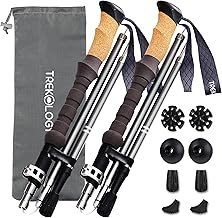
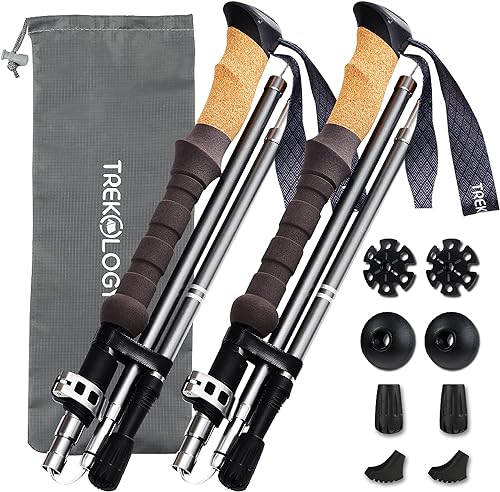
TREKOLOGY Trek-Z Cork Grip Folding Trekking Poles — best overall for carry-on travel
The Trek-Z is the pole most often recommended in travel-hiker forums because it nails the three things that actually matter for flying: it folds to about 15 inches (fits any 22-inch carry-on diagonally with room left over), it weighs roughly a pound per pair, and the cork grips don't get clammy on a long flight followed by a sweaty hike. The Z-fold mechanism uses an internal cord that snaps into place with a single push-button lock — no twisting, no slipping mid-trail. Tip kit ships with rubber feet, carbide tips, and snow baskets in the box, which is the easiest way to stay on the right side of TSA: install the rubber caps before you pack, leave the carbide tips in your checked bag or in a Ziplock at the bottom of your pack. Length is adjustable from roughly 39 to 53 inches, which covers most hikers from 5'2" to 6'4". TREKOLOGY Trek-Z Cork Grip Trekking Poles.
Nordic Lightweight 7075 Aluminum Trekking Poles — best for heavier loads and taller hikers
If you're over six feet tall, carrying a 30+ pound pack, or planning hut-to-hut trekking where pole reliability matters more than shaving grams, the Nordic 7075 aluminum poles are the upgrade pick. 7075-T6 aluminum is the same alloy used in aircraft frames — significantly stronger than the 6061 alloy most budget poles use, with better fatigue resistance over thousands of plant cycles. Collapsed length runs about 16 inches, which still clears every major international carry-on size limit (Ryanair's 55x40x20cm bag, Lufthansa's 55x40x23cm, United's 22x14x9 in). The slightly longer collapsed length comes from a more generous extended range, so taller hikers won't bottom out the locks. EVA foam grips with extended below-grip sleeves let you choke up on steep climbs without re-adjusting length. Nordic Lightweight 7075 Aluminum Trekking Poles.
Collapsible Aluminum Trekking Poles 2-Pack — best budget option and backup pair
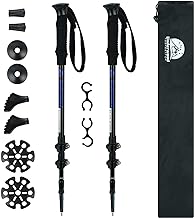
If you're testing whether trekking poles even fit your hiking style, or if you want a cheap second pair to leave in checked luggage as a backup, this 2-pack is the value play. Collapsed length sits around 15 inches, weight is competitive with the Trek-Z, and the included accessory kit covers rubber tips and mud baskets. Build quality is a step below the premium picks — expect the flip-locks to need occasional re-tensioning with the included Allen key — but for a flight-and-day-hike scenario in mild terrain, the poles are perfectly serviceable. Many travelers buy these as a "loaner pair" to hand to a hiking partner who didn't pack their own. Collapsible Aluminum Trekking Poles.
How to actually get folding trekking poles through TSA in 2026
The TSA rule hasn't changed: trekking poles are listed in the same category as ski poles and hiking sticks, and the official guidance says "check with airline." The unofficial reality at most US checkpoints is that folded poles inside a closed pack, with rubber tips installed, pass through X-ray screening without comment more than 90% of the time. The remaining ~10% get pulled for a bag check, and the agent's decision is at their discretion.
Three things shift the odds in your favor:
- Pack them inside, not outside. Poles clipped to the outside of a daypack are an immediate visual flag. Folded poles in a packing cube at the bottom of a carry-on roller almost never get pulled.
- Rubber caps on, carbide tips off or buried. The pointed carbide tip is what triggers "sharp object" objections. Most folding poles ship with screw-on rubber feet — use them in transit.
- Have a plan B. If you're pulled aside and the agent refuses, your fallback is gate-checking. Ask politely if you can gate-check the poles rather than abandon them — this works at most US gates if you have the time before boarding closes.
International varies. UK, EU, Japan, and Australia security generally allow folded poles in carry-on with no fuss. Some Middle East transit hubs (DXB, DOH) are stricter and may require check-in. When in doubt, the bombproof move is to fly with a soft-sided checked bag and put the poles inside it — adds 15 minutes at baggage claim, zero gate-side stress.
Sizing: getting the pole length right
Folding pole length adjustment usually has a 15-inch usable range (e.g. 39–53 inches or 100–135 cm). The right length puts your forearm parallel to the ground when the tip is planted next to your foot on flat terrain. Quick formula: your height in cm × 0.68 = pole length in cm. So a 5'10" hiker (178 cm) wants poles set to roughly 121 cm. Shorten by 5 cm for steep climbs, lengthen by 5 cm for sustained descents. If you fall outside the 5'2"–6'4" envelope, double-check the extended-length spec before buying — some compact folding poles top out at 130 cm, which is short for hikers over 6 feet. Our trekking pole sizing by height guide has a full chart.
Carry-on dimensions to plan around
If you're flying internationally, the airline with the tightest carry-on dimension dictates your pack. As of 2026 the practical worst case is Ryanair's free underseat allowance at 40x20x25cm — far too small for any folding pole. Their paid 10kg carry-on at 55x40x20cm fits a 16-inch (40cm) folded pole exactly, with no margin. Lufthansa, KLM, Singapore Airlines, and most US majors give you 55x40x23cm or larger, which is comfortable. The Trek-Z and the budget 2-pack at ~15 inches (38cm) clear every carrier. The Nordic 7075 at ~16 inches (40cm) clears all but the strictest budget-airline allowances.
What about carbon fiber folding poles?
Carbon poles save roughly 4–6 ounces per pair over aluminum, which sounds nice but matters less than you'd think for travel. The downside: carbon shafts can shatter rather than bend when wedged sideways under a falling boot or pinched in a rockfall. For a trip where you're checking a bag with the pole inside, baggage handlers' rough handling makes carbon a genuine liability. For carry-on-only travel where the pole stays in your hand or your pack the entire trip, carbon is fine — just expect to pay roughly 2x for the weight savings. Most travelers we hear from settle on 7075 aluminum as the sweet spot. See our folding vs telescoping trekking poles breakdown for the locking-mechanism deep dive.
Frequently Asked Questions
Can you bring folding trekking poles in carry-on luggage on a plane?
Technically TSA classifies trekking poles as "sharp objects" and recommends checked baggage. In practice, folded poles with rubber tip caps installed, packed inside a closed carry-on, pass through screening successfully most of the time on US domestic flights. The decision is at the screener's discretion, so always have a checked-bag or gate-check fallback. International rules vary — UK and EU are generally permissive, some Middle East hubs are stricter.
What is the shortest folding trekking pole when collapsed?
The shortest folding trekking poles on the market in 2026 collapse to about 13 inches (33 cm), achieved by 4-section designs with shorter individual segments. Most 3-section folding poles, including the Trek-Z and Nordic picks, collapse to 15–16 inches. Anything under 17 inches will fit a standard 22-inch carry-on diagonally with room for clothes.
Are folding or telescoping trekking poles better for backpacking travel?
Folding poles are better for travel because they pack roughly half the length of telescoping poles. Telescoping poles are slightly more durable under heavy load and offer a wider length-adjustment range, which is why ultralight thru-hikers without flight constraints sometimes prefer them. For anyone flying with poles, folding is the clear winner.
How much should good folding trekking poles weigh?
Quality aluminum folding poles weigh 0.9–1.2 pounds per pair. Carbon equivalents run 0.6–0.9 pounds per pair. Anything over 1.4 pounds per pair is either heavy-duty (designed for 50+ lb pack loads) or poorly designed. For airline travel, lighter is better since carry-on weight limits on international carriers can be as strict as 7 kg (15 lb) total.
Do I need carbide tips or are rubber tips enough?
Carbide tips bite into hardpack dirt, ice, and rock — essential for any trail with technical terrain. Rubber tips are required for pavement, indoor surfaces (airport floors), and TSA-friendly transit. Buy poles that ship with both and swap before leaving the trailhead. All three picks above include rubber caps in the box.
Can taller hikers (6'2" and up) use folding trekking poles?
Yes, but check the extended-length spec carefully. Many compact folding poles top out at 125–130 cm, which is short for hikers over 6 feet. The Nordic 7075 picks extend to about 135 cm (53 in), which is the practical maximum and comfortable for hikers up to 6'4". Above that height, a telescoping pole may be the only option.
Will trekking poles set off airport metal detectors?
Aluminum trekking poles will show clearly on X-ray imaging but won't trigger walk-through metal detectors since you don't carry them through. The X-ray operator sees the shape, recognizes it as poles, and either passes them through or pulls the bag for inspection. Carbon poles are nearly invisible on X-ray, which occasionally triggers a closer look but rarely a refusal.
The bottom line
For most travelers flying with hiking plans in 2026, the TREKOLOGY Trek-Z is the best folding trekking poles for airline carry on pick — it's the lightest, shortest, and cheapest of the three at a quality tier that won't fail on you. Step up to the Nordic 7075 if you're tall, hauling weight, or planning multi-day trips where reliability matters. Grab the 2-pack if you want a backup pair or a cheap entry point to see whether trekking poles fit your hiking style. Whichever you pick, install the rubber tip caps before you pack, slide the folded poles into the main compartment of your carry-on, and you'll get through screening without drama.
Key Takeaways
- Choosing the right best folding trekking poles for airline carry on means matching the key features to your specific needs and budget
- Read real customer reviews and check the return policy before you commit
- Also covers: Z fold trekking poles fit carry on
- Also covers: collapsible poles TSA backpack travel
- Also covers: compact folding poles plane allowed
- Compare value across models — the priciest option is not always the best fit