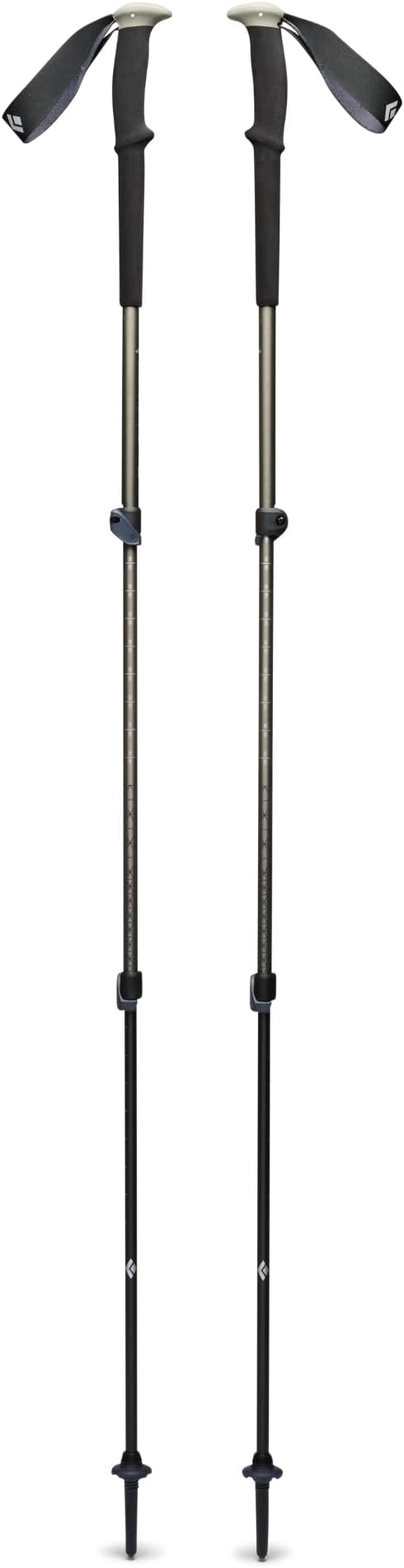
If you stand 6'5" or taller, most trekking poles on the rack top out around 130-135cm — barely enough to keep your wrists at a neutral 90-degree angle on flat ground, and useless once the trail tilts downhill. The best trekking poles for tall hikers over 6 foot 5 extend to at least 140cm (55 inches), use 7075-series aluminum or carbon shafts that resist lateral flex under taller-rider leverage, and lock with external flip-levers rather than internal twist mechanisms that creep under load. In this 2026 guide we walk through three real options that actually fit oversized frames, plus a comparison table, sizing math, and a long FAQ covering wrist angle, pack-down length for airline carry-on, and why grip diameter matters more when your hands are bigger.
Quick sizing rule before we start: take your height in centimeters and multiply by 0.68. A 6'5" hiker (196 cm) needs roughly 133 cm as a flat-ground baseline, and you want at least 5-7 cm of headroom above that for uphill terrain shortening and grip-choke adjustments. That means a pole that maxes out at 135 cm is the floor, not the ceiling — and it's why so many tall hikers end up hunched, hiking with bent wrists, or replacing poles within a season. Every product below clears 140 cm.
The best best trekking poles for tall hikers over 6 foot 5 for your situation depends on how you plan to use it and where.
What makes a trekking pole work for hikers over 6'5"
Top Picks
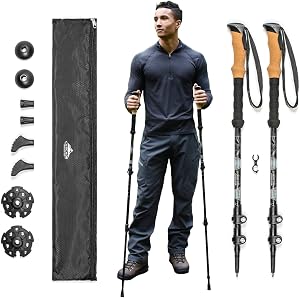
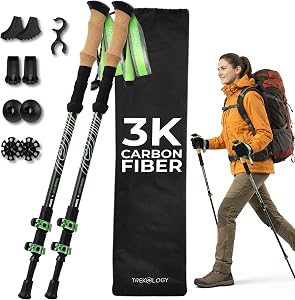
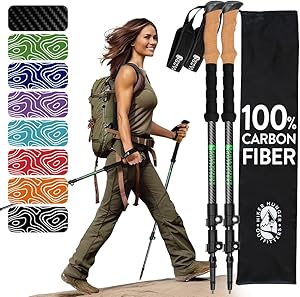
Comparison: extra-long trekking poles for tall hikers in 2026
| Pole | Max length | Shaft material | Lock type | Packed length | Best for |
|---|---|---|---|---|---|
| Nordic Lightweight 7075 Aluminum | 140 cm | 7075 aluminum | External flip-lock | ~65 cm | Day hikes, dayhike-to-multiday, heavy users |
| TREKOLOGY Trek-Z Cork Grip Folding | 135 cm | 7075 aluminum, Z-fold | Push-button + flip-lock | ~38 cm | Fastpacking, trail running, carry-on travel |
| Collapsible Aluminum 2-Pack | 135 cm | Aluminum alloy | Twist/flip combo | ~62 cm | Budget backup pair, lending to hiking partners |
Three things, in order of importance. Maximum extended length comes first — if the pole physically cannot reach the height your arm geometry requires, nothing else matters. Shaft stiffness comes second, because a taller hiker applies more torque at the wrist with every plant; flexy poles whip sideways and waste energy, and on steep descents that flex turns into an unexpected collapse. Grip ergonomics comes third: bigger hands need a thicker grip circumference (most poles are sized for ~85th-percentile male hands, which leaves 99th-percentile users cramping after three hours).
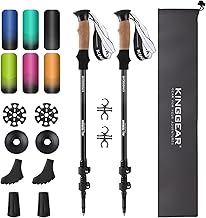
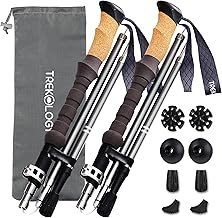
Secondary factors include lock type (external flip-lever beats twist-lock for big-hiker leverage), tip swap-ability (carbide for rock, rubber for pavement approaches), and packed length if you fly to trailheads. For thru-hikers and ultralight backpackers, weight matters — but for the over-6'5" crowd it should never be the top filter, because a 200g savings on a pole that's 8cm too short is a bad trade.
Of these three, only the Nordic 7075 reaches the 140 cm mark that genuinely fits hikers in the 6'5" to 6'8" range without choking the grip on flat terrain. The TREKOLOGY Trek-Z is a great secondary pole for travel — its Z-fold collapses to under 40 cm, which fits inside a 22" carry-on — but at 135 cm max you'll feel slightly cramped on extended flat sections. The budget 2-pack is a sensible backup or guest-loaner, not your primary.
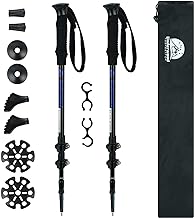
Nordic Lightweight 7075 Aluminum Trekking Poles — best overall for hikers over 6'5"
These are the only poles in this roundup that hit a true 140 cm extended length, which is the magic number for hikers in the 6'5" - 6'8" window. The 7075-T6 aluminum shaft (the aerospace-grade alloy used in bike frames and rifle receivers) is meaningfully stiffer than the more common 6061 aluminum, and that stiffness shows up immediately when you're a heavier, taller user applying real downward force on a descent. The external flip-lock cams are oversized and adjustable with a Phillips screwdriver if they ever loosen — a small detail that matters when you're putting 200+ lbs of leverage through the pole on a river crossing. EVA foam grips are a touch shorter than I'd ideally want for a 99th-percentile hand, but the foam extends down the upper shaft so you can choke up on uphills without sliding onto bare metal. Tungsten carbide tips, swappable rubber boots, and snow baskets are included.
The honest tradeoff: at ~280g per pole they're not the lightest on the market. For a tall hiker that's a non-issue — you'd spend the weight savings on a flexier pole that whips under load anyway. Nordic Lightweight 7075 Aluminum Trekking Poles.
TREKOLOGY Trek-Z Cork Grip Folding — best travel and fastpacking option
The Trek-Z is the pole I'd recommend as a second pair if you fly to trailheads, fastpack, or run technical trail. The three-section Z-fold collapses to roughly 38 cm — that's short enough to disappear inside a 40L carry-on backpack, which solves the perennial "do I check my poles or risk TSA confiscating them" problem. The cork grip is the standout feature for tall hikers with larger hands: cork molds to your palm shape over the first 5-10 hours of use, distributes pressure better than EVA foam, and stays grippy when wet with sweat (foam gets slick). The combination of a push-button release for the Z-fold sections and a single flip-lock for the top sliding section means you can deploy the pole from packed to fully extended in about four seconds.
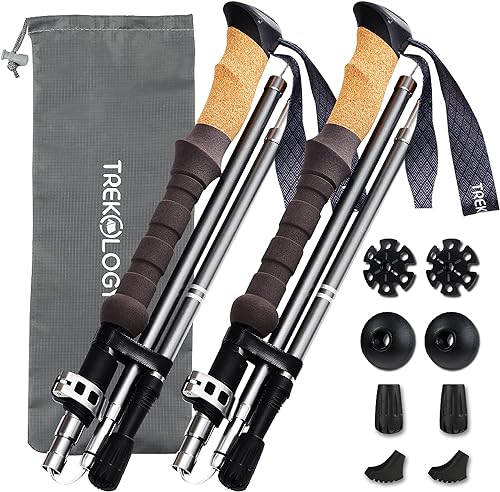
The catch for over-6'5" users is the 135 cm ceiling. That's adequate for downhills and uphills (where you want a shorter pole anyway), but on long flat sections you'll be hiking with a wrist angle slightly below neutral. For most tall hikers that's acceptable as a tradeoff for the packability; for the tallest users (6'7"+) it's a real ergonomic compromise. TREKOLOGY Trek-Z Cork Grip Trekking Poles.
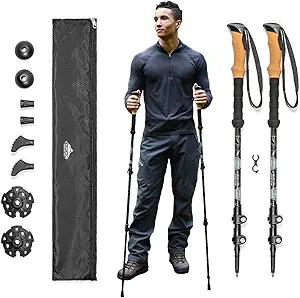
Collapsible Aluminum Trekking Poles 2-Pack — best budget backup or loaner pair
This 2-pack is not a primary recommendation for an over-6'5" hiker — the 135 cm max length and generic aluminum alloy are the same compromises you'll find in any sub-$40 pole. Where it earns a slot in this guide is as a second set: poles for a shorter hiking partner you take out a few times a year, a backup pair to keep in your truck, or a loaner for guests visiting your area. The flip-twist combo lock holds well enough for moderate trails and lighter loads. They're not poles I'd take on a 14er or a serious thru-hike, but for $30-ish, they're a perfectly reasonable bench player.
If you're a tall hiker buying these as your primary, expect to upgrade within a season — the shaft flex is noticeable once you're applying real torque, and the grips are sized for average-height users. Collapsible Aluminum Trekking Poles.
How to size trekking poles when you're over 6'5"
The standard formula — height in cm × 0.68 — gives you the flat-ground baseline, but tall hikers need to think about it in three terrain modes. On flat trail, set the pole so your elbow sits at exactly 90 degrees when the tip is on the ground next to your foot; for a 6'5" hiker that's typically 130-135 cm. On uphill, shorten by 5-10 cm so the pole tip plants at hip height as you step forward — this gives you something to push off without overreaching. On downhill, lengthen by 5-10 cm above flat to keep your tip reaching downslope without you having to bend at the waist.
Practical implication: a pole with only a 135 cm max gives you exactly zero headroom for downhill mode. You'll hike descents leaning forward, which compresses your lumbar spine and is the #1 cause of "I hated trekking poles" reviews from tall users. The 140 cm max on the Nordic 7075 is the floor for true three-mode sizing.
Frequently Asked Questions
What length trekking poles do I need if I'm 6 feet 7 inches tall?
At 6'7" (201 cm), your flat-ground baseline is about 137 cm, and you want at least 142-145 cm for downhill use. That puts you above the max length of nearly every commercial pole, including the three in this guide. The Nordic 7075 at 140 cm is the closest fit available without going to custom or specialty builds — you'll hike flat ground with a wrist angle about 3-5 degrees below ideal, which is a manageable compromise. For genuine 145 cm+ poles, you'll need to look at specialty Nordic walking poles (different grip geometry) or custom carbon builds, both of which sit outside the under-$100 mainstream market. See our trekking pole sizing chart by height for the full table.
Are extra-long trekking poles heavier than standard-length ones?
Slightly, but not as much as you'd expect. The additional shaft material on a 140 cm pole versus a 130 cm pole adds about 15-25g per pole — under an ounce per hand. The bigger weight driver is shaft material and wall thickness: a stout aluminum 140 cm pole runs around 280-320g, while a thin-walled carbon 130 cm pole can come in under 200g. For tall hikers I strongly favor the heavier aluminum option because shaft stiffness under high-leverage load is far more important than the modest weight savings.
Can I bring folding trekking poles in carry-on luggage?
In the United States, TSA officially prohibits trekking poles in carry-on as of 2026 — they're classified alongside ski poles as "sporting goods" that must be checked. In practice, the Z-fold style poles like the TREKOLOGY Trek-Z (collapsed to ~38 cm) frequently pass through carry-on screening without comment because they don't read as poles on the X-ray, but this is at the discretion of the individual screener and you should not count on it. Most European, Canadian, and Asian airports follow similar rules. The safer play is to pack folding poles in a checked bag or in your hold-luggage backpack.
What's the difference between cork, EVA foam, and rubber grips for tall hikers?
Cork is the best choice for hikers with larger hands and sweaty palms — it molds to your hand shape over time, breathes well, and stays grippy when wet. EVA foam is softer initially and lighter, but compresses permanently within a season of heavy use and gets slippery when wet. Rubber grips transfer vibration the most and are best avoided for long-distance hiking; they're acceptable for short day hikes in cold weather where rubber's insulation helps. For an over-6'5" hiker who will spend hours per day with weight on the grip, cork is worth the small premium.
Are carbon fiber trekking poles strong enough for hikers over 240 pounds?
Quality carbon fiber poles from major brands are rated for users up to about 260 lbs static load, but the failure mode matters: carbon fails suddenly and catastrophically (shatter) where aluminum fails gradually (bend you can hike out with). For a tall, heavier hiker — especially solo or in remote terrain — aluminum's bend-don't-break behavior is a meaningful safety margin. The 7075-aluminum option in this guide is what I'd recommend over any carbon pole for users above 220 lbs. See our aluminum vs carbon trekking poles deep dive for the full breakdown.
How tight should the flip-lock cams be on my trekking poles?
Tight enough that you cannot collapse the pole by pushing down on it with your full body weight, but loose enough that the lever closes with firm thumb pressure rather than requiring two hands. If you have to wrestle the lever closed, the cam is over-tight and will wear the shaft. If the pole slips under load, tighten the small adjustment screw on the lever a quarter turn at a time until it holds. Check this monthly during heavy use — aluminum cams loosen slightly as the shaft polishes itself in.
Do I really need two trekking poles, or is one enough for tall hikers?
Two. For a tall hiker, the energy-distribution argument is even stronger than for an average-height user: your longer limbs generate more lateral sway with each stride, and two poles cancel that sway in both directions. One pole helps on a specific descent but actually amplifies asymmetric stress on your hips and lower back over a multi-hour hike. The only case for a single pole is when you need a free hand for a camera or a leashed dog, and even then the asymmetric load shows up as soreness the next day. Buy a pair. Always a pair.
How do I know when to replace my trekking poles?
Three signals. First, visible shaft bend — sight down the pole in good light; any curve more than ~2 mm over the full length means retire it. Second, lock slippage that won't tighten — once the cam-to-shaft contact surface is polished smooth, adjustment screws stop holding. Third, grip compression — when the foam or cork no longer rebounds to original diameter after 24 hours of rest, it's no longer absorbing vibration and is just transferring it into your wrists. Quality aluminum poles typically last 800-1500 trail miles for a tall heavier user; carbon poles often retire earlier from impact damage. See our trekking pole maintenance guide for cleaning and storage that extends usable life.
Key Takeaways
- Choosing the right best trekking poles for tall hikers over 6 foot 5 means matching the key features to your specific needs and budget
- Read real customer reviews and check the return policy before you commit
- Also covers: extra long trekking poles for tall men
- Also covers: trekking poles 140cm max length
- Also covers: trekking poles for hikers over 200cm
- Compare value across models — the priciest option is not always the best fit