The best trekking poles with camera mount for hiking vloggers in 2026 are lightweight aluminum or carbon poles featuring a standard 1/4"-20 threaded top under the grip cap—letting you screw in a GoPro, DJI Osmo, or compact mirrorless camera and instantly convert one pole into a stabilized monopod. For most YouTubers, TikTokers, and travel vloggers, the sweet spot is a 7075-aluminum pole around 8–10 oz per side with cork or EVA grips, flick-lock adjustment, and a removable top cap exposing the camera thread. Below we break down the top picks, what to look for, and how to film smoother trail content without lugging a separate tripod.
Hiking vloggers have specific needs that casual trekkers don't: you want a pole you can grab one-handed mid-stride, screw a camera onto in under five seconds, and trust at full extension while you walk-and-talk. The best trekking poles with camera mount compatibility hide a universal 1/4"-20 thread beneath a twist-off knob or rubber cap on top of the grip—exactly the same thread every action cam, gimbal, and mirrorless body uses. That single design detail is what separates a vlogger-friendly pole from a generic hiking stick.
What Makes a Trekking Pole Camera-Mount Ready in 2026
Top Picks
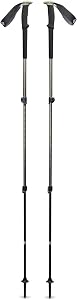
Comparison: Top Trekking Poles With Camera Mount Compatibility for 2026
| Pole | Material | Weight (pair) | Lock Type | Grip | Camera Mount | Best For |
|---|---|---|---|---|---|---|
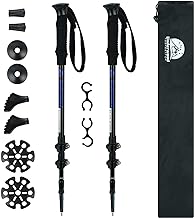
| Nordic Lightweight 7075 Aluminum | 7075 aluminum | ~18 oz | Flick-lock | EVA foam | 1/4"-20 under cap | Daily vlogger workhorse |
| TREKOLOGY Trek-Z Cork Grip Folding | Aluminum | ~19 oz | Z-fold + flick | Natural cork | 1/4"-20 under cap | Travel & fly-in vloggers |
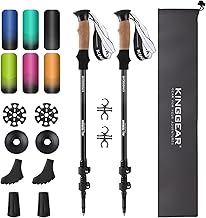
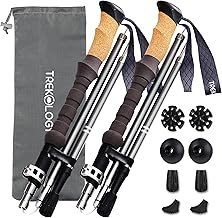
| Collapsible Aluminum 2-Pack | Aluminum | ~20 oz | Twist + flick | EVA foam | 1/4"-20 under cap | Budget creators & beginners |
Not every pole on Amazon advertises a camera mount, but many aluminum and carbon models actually have the thread built in—the cap just unscrews to reveal it. Before buying, look for these five features:
- 1/4"-20 universal thread under the top cap — the standard for GoPro adapters, DJI Osmo Action, Insta360, Sony ZV-1, and tripod quick-release plates.
- Flick-lock (lever-lock) adjustment — far more vibration-resistant than twist-locks when you're filming at full extension.
- Cork or EVA grip — absorbs micro-tremors that show up on camera as shaky footage.
- Weight under 10 oz per pole — so holding one overhead for a tracking shot doesn't ruin your arm by mile three.
- Padded wrist strap you can drop without losing the pole — critical for two-handed camera operation while still tethered.
If you're new to trail filming, check our guide to lightweight trekking poles for ultralight backpacking for general weight benchmarks, and GoPro accessories for hiking vloggers if you're still building out your camera kit.
Our Top Picks for Hiking Vloggers in 2026
1. Nordic Lightweight 7075 Aluminum Trekking Poles — Best Overall for Vloggers
If you film 80% of your content on the move and want one pole that handles 14er pushes, river crossings, and walk-and-talks without flexing, the Nordic 7075 Aluminum poles are the strongest pick of the three. 7075 aerospace-grade aluminum is roughly 60% stronger than the standard 6061 used in most budget poles, which translates directly to less micro-wobble when a camera is screwed to the top. The flick-lock cams hold tension under sustained sideload (the kind you get when leaning the pole for a low-angle drone-style shot), and the top cap unscrews cleanly to expose a 1/4"-20 thread compatible with any GoPro tripod adapter, DJI Osmo magnetic mount, or mirrorless quick-release plate.
For vloggers specifically, the EVA grip extension running 6+ inches down the shaft is a sleeper feature—it lets you choke down for low-angle hero shots without losing thermal insulation in cold weather. At around 9 oz per pole, you can hold one overhead for a 30-second tracking shot without your shoulder giving out. Check current pricing and color options here: Nordic Lightweight 7075 Aluminum Trekking Poles
2. TREKOLOGY Trek-Z Cork Grip Folding Trekking Poles — Best for Travel Vloggers
If you fly to film, the Trek-Z is the pole to grab. The Z-fold (tent-pole style) design collapses to roughly 15 inches—small enough to fit inside a 40L carry-on backpack alongside your camera body, lenses, and drone. That's a real-world advantage over telescoping poles, which max out around 24 inches collapsed and force you to gate-check or buy a separate tube. Deployment is fast: snap the segments together, flick the upper lock to dial length, and you're filming in about 8 seconds.
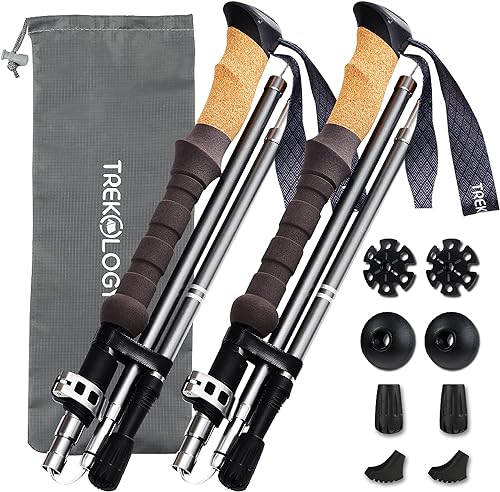
The natural cork grip is the standout for camera work. Cork dampens hand sweat and high-frequency vibration better than EVA or rubber, which means cleaner audio on the built-in mic of whatever camera you've mounted up top. The top cap unscrews to reveal the same standard 1/4"-20 thread the other poles use, so your existing GoPro mount or Ulanzi adapter screws right in. Vloggers who shoot in humid climates—Hawaii, Costa Rica, Southeast Asia—will appreciate that cork doesn't get slimy the way foam can after eight sweaty miles. Grab them here: TREKOLOGY Trek-Z Cork Grip Trekking Poles
3. Collapsible Aluminum Trekking Poles, 2-Pack — Best Budget Pick for New Creators
You don't need to spend $150 to start filming professional-looking trail content. This 2-pack delivers the core feature set—telescoping aluminum, EVA grip, removable top cap exposing a 1/4"-20 thread, and tungsten carbide tips—at a price point that won't sting if you accidentally bend one in a scree field on month one. For a vlogger figuring out whether the trail-vlog format is for you, that risk tolerance matters more than spec-sheet perfection.
The dual-lock system (twist-lock for lower shaft + flick-lock for upper) is a bit more fiddly than pure flick-lock setups, but for camera-mount use you'll typically set length once and leave it. They also include rubber tip protectors, mud baskets, and snow baskets in the box—an underrated bonus for vloggers who film year-round content. If you're pairing them with a smartphone in a clamp adapter or a sub-200g action cam, the strength reserves are more than enough. Pick them up here: Collapsible Aluminum Trekking Poles
How to Actually Mount a Camera on a Trekking Pole
The mechanical part is simple, but a few details separate "footage I can use" from "footage I'll delete." First, unscrew the top cap—on all three poles above, this is the rubber or plastic knob at the very top of the grip. You'll see a recessed 1/4"-20 threaded hole. Don't force it; if it resists, the cap usually unthreads counterclockwise but some models have a friction-fit cap that lifts straight off.
Next, choose your adapter. For a GoPro, you need a tripod-mount adapter (the little flat plate with the prong fingers) plus a thumb screw. For a DJI Osmo Action 4 or 5, the magnetic quick-release base has 1/4"-20 built in. For mirrorless bodies (Sony ZV-E10, Canon R50), screw on a small quick-release clamp like an Arca-Swiss compatible plate so you can detach the camera without unmounting from the pole.
Tighten finger-tight only—over-torquing strips the soft aluminum threads inside the pole cap. Add a safety tether (a $3 lanyard from the pole strap to the camera body) so a slip doesn't send your $400 action cam down a talus slope. For walk-and-talks, extend the pole to about chin-height and grip the shaft mid-way, not at the top grip—this acts as a poor man's gimbal and kills 60% of vertical bounce.
Frequently Asked Questions
Do all trekking poles have a 1/4"-20 camera thread under the top cap?
No—it's common but not universal. Most aluminum and carbon poles made in the last five years include a 1/4"-20 thread because manufacturers know vloggers and photographers ask for it, but some ultralight carbon poles use a sealed cap to save weight, and some budget poles have a plastic cap with no thread at all. Before buying, check product photos for a clearly removable top knob, and read recent reviews searching for "camera" or "GoPro"—real users will confirm whether the thread is there.
Can I use a trekking pole as a monopod for a full-frame mirrorless camera?
Yes for bodies under about 2 lbs (including lens)—Sony A7C, Canon R8, Nikon Zf with a small prime. The 7075 aluminum poles handle the load fine, but you'll want a flick-lock pole (not twist-lock) because twist-locks can slowly slip under sustained vertical load. For anything heavier—an R5 with a 24-70 f/2.8, for example—buy a dedicated carbon monopod. Trekking poles aren't engineered for static long-exposure work; they're designed for impact loads at an angle.
What's the best trekking pole height setting for hiking vlog walk-and-talk shots?
Set the pole so the camera lens lands at roughly your chin height when you hold the pole vertically with a slightly bent elbow. This gives a flattering low-to-mid angle (avoiding the dreaded up-the-nose framing) and keeps the lens above hip-pack and shoulder-strap clutter. For most vloggers between 5'6" and 6'2", that's a pole extension between 110 cm and 130 cm. Mark the setting with a sharpie strip on the shaft so you can redeploy it in seconds.
Are carbon fiber or aluminum trekking poles better for camera-mount use?
Aluminum—specifically 7075 aluminum—is better for vloggers. Carbon is lighter and absorbs high-frequency vibration well, but it fails catastrophically when overstressed (it doesn't bend, it shatters). Mounting a camera adds rotational moment that carbon doesn't love, and a cracked carbon pole 12 miles from the trailhead is a much worse day than a slightly bent aluminum one. Save carbon for fastpacking when you're not filming.
Do folding (Z-fold) trekking poles work as well as telescoping ones for camera mounts?
Yes, with one caveat: folding poles have a tensioned internal cord that can introduce a tiny amount of play at the joints. For static shots you won't notice, but if you're doing long-exposure or astrophotography from a pole, telescoping is more rigid. For 99% of vlog content—walk-and-talks, B-roll tracking shots, hero pans—folding poles like the TREKOLOGY Trek-Z perform identically to telescoping models and pack way smaller for travel.
How do I stop my trekking pole camera footage from being shaky?
Four fixes, in order of impact: (1) enable your camera's electronic stabilization—GoPro HyperSmooth, DJI RockSteady, Insta360 FlowState all handle pole shake well; (2) grip the pole at the mid-shaft, not the top grip, to shorten the lever arm; (3) walk with a deliberate heel-to-toe rolling gait, not a normal stride; (4) shoot at 60fps or higher so you can slow footage to 30fps in post, which masks remaining jitter. Together these make pole footage indistinguishable from gimbal footage for most viewers.
Can I leave the camera mounted while using the pole for actual hiking?
Short transitions yes, sustained hiking no. Planting a pole with a camera attached transmits impact straight into the camera body and lens elements over thousands of footfalls per mile—not good for longevity. The smart workflow is: pole-as-pole on the climb, stop at the viewpoint or interesting section, unscrew the cap or swap to your camera quick-release, shoot, then revert. The poles above all allow a sub-10-second swap, which is fast enough to capture spontaneous moments without ever truly "committing" the camera for a full hiking day.
For more trail-creator gear, check our deep dives on hiking backpacks with camera compartments and action cameras for trail running in 2026.
Key Takeaways
- Choosing the right best trekking poles with camera mount means matching the key features to your specific needs and budget
- Read real customer reviews and check the return policy before you commit
- Also covers: GoPro mount trekking pole hiking vlog
- Also covers: monopod trekking pole hybrid
- Also covers: camera screw thread trekking pole
- Compare value across models — the priciest option is not always the best fit