After mastectomy surgery, returning to the trail is one of the most healing things a survivor can do — but standard hiking packs can press on tender scar tissue, irritate drains, or compress reconstruction sites. The best hiking backpack for mastectomy recovery is one that distributes weight to the hips instead of the chest, offers a movable or removable sternum strap, uses soft adjustable shoulder padding, and stays under two pounds empty. This guide breaks down the features that actually matter in 2026, how to retrofit your favorite pack, and which trekking poles can take 20–30% of the chest load off your healing tissue entirely.
Why standard hiking backpacks fail mastectomy patients
Top Picks
Most off-the-shelf daypacks are designed around an idealized male torso: a fixed sternum strap sits 4–6 inches below the collarbone, which is precisely where lumpectomy scars, port-site incisions, expander valves, and DIEP flap suture lines tend to be most sensitive. Even months after surgery, that horizontal compression band can:
- Aggravate cording (axillary web syndrome) along the inner arm and chest wall
- Press directly on tissue expanders, making the pressure-pump valve sting
- Rub against radiation-fragile skin during the 6–18 month rebuild window
- Concentrate shoulder load on lymph-node-dissection arms, raising lymphedema risk
The fix is not "no chest strap" — a sternum buckle is what keeps the shoulder straps from sliding outward and dumping weight onto the trapezius. The fix is a movable, padded, low-tension chest strap paired with an aggressive hip belt that pulls 70%+ of the pack weight off your shoulders entirely.
Features the best hiking backpack for mastectomy recovery actually needs
1. Rail-mounted (not sewn) sternum strap
Look for daisy-chain or ladder-lock rails on both shoulder straps so the chest buckle slides up toward the collarbone or down toward the sternum-xiphoid junction. Osprey's Bio-Stretch rail, Gregory's JetStream rail, and Deuter's VariSlide all allow 3–4 inches of vertical adjustment, letting you route the buckle entirely off scar tissue.
2. Sub-2-pound base weight
A 28L pack should weigh under 32 ounces empty. Every ounce you carry rests partly on your shoulder yoke, which transmits force across the upper chest. Ultralight 2026 fabrics (Robic 100D, UHMWPE gridstop) cut chest pressure noticeably without sacrificing durability.
3. Wraparound, structured hipbelt
The hipbelt is where 70%+ of the pack weight should live during recovery. A foam-padded, dual-density wing that wraps the iliac crest pulls weight off the chest entirely. Avoid thin webbing belts — they don't transfer load and leave the chest to absorb everything.
4. Front-load access or panel zip
Top-loading packs force you to lift the bag overhead and torque your shoulders. A panel-zip or U-zip design lets you pack at waist height with no overhead reach, which is critical in the first 6–12 weeks post-op when shoulder ROM is still rebuilding.
5. Trekking pole attachment loops
This is non-negotiable. Even if you don't think you'll need poles, you will. Poles are the single biggest game-changer for post-mastectomy hikers — more on that next.
The trekking pole trick: offload your chest entirely
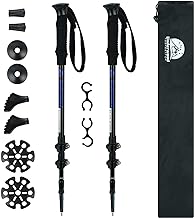
Here's the thing nobody mentions in the standard recovery handouts: trekking poles don't just help with knees. Used properly, a pair of poles transfers 20–30% of your bodyweight plus pack weight to your arms and the ground, which means your shoulder yoke and chest strap carry dramatically less force. For a hiker recovering from chest-wall surgery, that load reduction often makes the difference between "I can do 4 miles" and "I can do 10."
The mechanics are simple: each pole plant pushes down through your forearm to the ground, momentarily unloading the spine and shoulders. Across a 6-hour hike, that's tens of thousands of micro-offloads of the exact tissue you're trying to protect. For more on building a recovery-friendly kit, see our guide to lightweight daypacks for lymphedema patients and our overview of trekking poles for shoulder and upper-body injuries.
Comparison: trekking poles that take pressure off your chest in 2026
| Pole | Weight (pair) | Shaft material | Grip | Best for recovery |
|---|---|---|---|---|
| Nordic 7075 Aluminum | ~18.7 oz | 7075 aluminum | EVA foam | Lowest-cost reliable workhorse |
| TREKOLOGY Trek-Z Cork | ~15.5 oz | 7075 aluminum (Z-fold) | Natural cork | Smallest pack-down + sweat-free grip |
| Collapsible 2-Pack | ~19 oz each | Aluminum alloy | EVA foam | Budget pair for couples or trail buddies |
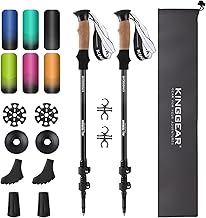
Nordic Lightweight 7075 Aluminum Trekking Poles
These are the workhorse poles I recommend first for almost every mastectomy-recovery hiker. The 7075 aluminum shafts are strong enough to bear full body weight on a rough descent — critical when your chest can't absorb a stumble — while the EVA foam grip is soft enough that swollen or numb post-surgical hands won't develop hotspots over a long day. Twist locks hold tension reliably even after radiation-related grip-strength loss, and the included rubber tips dampen vibration through the wrist on hardpack. Buy them here: Nordic Lightweight 7075 Aluminum Trekking Poles
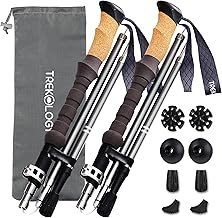
TREKOLOGY Trek-Z Cork Grip Folding Trekking Poles
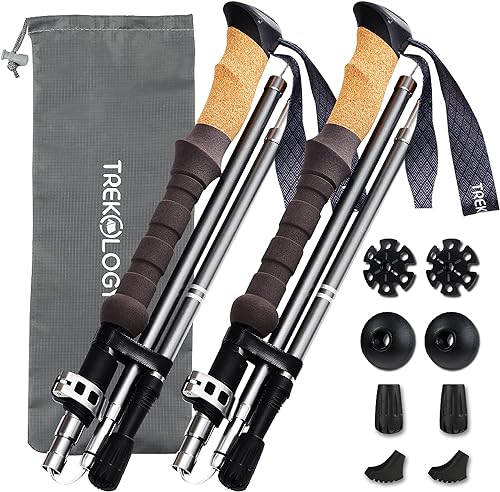
The Trek-Z is the pole I hand to anyone whose surgical bra or compression garment means they can't tolerate a bouncing pole strapped to the outside of a pack. The Z-fold collapses to roughly 15 inches — short enough to slide vertically inside a 28L daypack so nothing bumps your chest scar on every step. The cork grip is the standout feature: cork wicks sweat, molds to your palm over time, and doesn't blister neuropathy-prone fingers the way rubber does. The push-button release is also one-handed, which matters if your dominant-side range of motion is still limited. Order them here: TREKOLOGY Trek-Z Cork Grip Folding Trekking Poles
Collapsible Aluminum Trekking Poles, 2-Pack
If you're hiking with a partner — a spouse, a survivor friend, an oncology-trained guide — this 2-pack is the most cost-effective way to outfit both of you at once. Two pairs of telescoping aluminum poles with EVA grips ship together for the price most brands charge for a single pair. The flick-locks open and close one-handed, the wrist straps are wide enough to support an affected arm without cinching the wrist (important for lymphedema-prone sides), and adjustment range covers hikers from 4'10" to 6'5". Pick up the pair here: Collapsible Aluminum Trekking Poles, 2-Pack
How to retrofit a backpack you already own
You don't necessarily need a new pack. If your current daypack has the bones of a good fit, these 2026-friendly mods can convert it into the best hiking backpack for mastectomy recovery without dropping $200 on a brand-new bag:
- Move the sternum strap up. Most rails allow 2–3 inches of travel. Slide it to sit on the upper sternum, above the breast line and any reconstruction site.
- Add silicone tubing. Slip 4–6 inches of clear aquarium silicone tubing over the chest strap webbing where it crosses scar tissue. The tubing distributes pressure over twice the surface area.
- Re-pad shoulder straps with moleskin. Adhesive 1/8" closed-cell foam (or molefoam) on the underside of each shoulder strap reduces point pressure on the upper pectoral region.
- Tighten the hipbelt aggressively. The belt should sit on your iliac crest, not your waist. Cinched correctly, it lifts the entire pack 1–2 inches off your shoulders.
- Use the load-lifter straps. Most quality daypacks have load-lifters angling from the top of the shoulder yoke to the top of the pack. Tighten until the pack body sits flush against your upper back — this rolls weight forward to your hips instead of straight down through your chest.
Building a complete post-mastectomy hiking kit
A pack and poles alone aren't enough. Round out the kit with:
- A post-surgical sports bra with front zip closure (no overhead reach) and a wide, soft band that sits below the pack's hipbelt line
- Seamless moisture-wicking base layer — bamboo or merino — to prevent strap-on-skin chafing along scar lines
- A lymphedema sleeve on the affected arm if you had axillary node dissection, especially at altitude
- Electrolyte tabs — tamoxifen and aromatase inhibitors increase dehydration risk, and dehydration tightens muscles around healing tissue
- A small medical card in an outside pocket listing your surgical history, current meds, allergies, and emergency contact
For more recovery-aware gear curation, see our guide to post-surgery sports bras for hikers.
What to avoid in 2026
Skip these features when shopping for the best hiking backpack for mastectomy recovery:
- Fixed-position sternum straps sewn directly to the shoulder strap — impossible to move off scar tissue
- Vest-style running packs with two front pockets pressing on each chest wall
- Roll-top closures requiring overhead reach in the first six months post-op
- Heavy frame sheets over 3 pounds — the frame itself becomes the load
- Single-strap sling bags that put all weight asymmetrically on one shoulder, especially the dissection side
Frequently Asked Questions
How soon after mastectomy surgery can I start hiking with a backpack?
Most reconstructive surgeons clear patients for light hiking with no pack at 4–6 weeks post-op, day hiking with a 5-pound pack at 8–12 weeks, and full-day hiking with a 15-pound pack at 6 months. Always confirm with your specific surgical team — DIEP flap, TRAM flap, expander-and-implant, and aesthetic flat closure all have different healing timelines. The shoulders are usually cleared before the chest wall is.
What's the best chest strap position for hiking after a double mastectomy?
For most patients, the sternum strap should sit either at the upper sternum (just below the suprasternal notch) or low at the xiphoid process — never across the breast mound or reconstruction site. A rail-mounted, slide-adjustable strap is essential. Many post-mastectomy hikers also wear the strap looser than recommended, treating it as a yoke stabilizer rather than a load-bearing element.
Are trekking poles really necessary during mastectomy recovery hiking?
Necessary, no. Game-changing, yes. Biomechanics studies on trekking poles show 12–25% reduction in vertical impact force on the spine and shoulders, which translates directly to less load on the upper chest. For a hiker recovering from chest-wall surgery, that load reduction often expands what's possible by miles. Folding cork-grip poles like the Trek-Z are the most recovery-friendly because they stow inside the pack when not in use.
What pack volume is best for post-mastectomy day hikes?
22–28 liters is the sweet spot. Smaller (under 18L) forces you to skip essentials like extra water for medication side effects. Larger (over 35L) tempts you to overpack and adds frame weight that bears on the chest. A 25L pack at roughly 28 ounces empty, loaded to 12 pounds total, is the post-surgery benchmark most oncology-aware physical therapists recommend.
Can I hike with tissue expanders or during active radiation treatment?
With expanders, light hiking is usually approved 3–4 weeks after each fill, but the pressure of any chest strap directly over a port valve will sting — keep the strap low or remove it entirely and rely on pole-driven balance. During active radiation, skin fragility makes any chest strap inadvisable; this is the time to switch to a fanny-pack style waist setup carrying only essentials, a hydration vest worn backwards, or load all weight to poles and a belt-only carry.
Does a backpack hip belt raise lymphedema risk?
A properly fitted hip belt is actually protective against lymphedema, not a risk, because it removes load from the affected arm and shoulder. The real risks are (a) tight shoulder straps compressing the axillary lymph chain, and (b) the sternum strap restricting upper-chest lymph drainage. Loose straps, a tight hipbelt, and trekking poles together form the gold-standard lymphedema-safe configuration.
Are women-specific backpacks better for mastectomy hikers?
Sometimes, but not automatically. Women's packs typically have narrower shoulder straps, shorter torso lengths, and S-curved straps shaped around the breast. The S-curve can be a problem post-mastectomy because it's molded to a chest contour that may no longer match yours — especially after aesthetic flat closure or unilateral reconstruction. A straight-cut unisex or men's small pack with a rail-mounted sternum strap is often a better fit than a women's-specific pack with sewn-in curves.
Key Takeaways
- Choosing the right best hiking backpack for mastectomy recovery means matching capacity and output ports to your actual devices
- Always check actual watt-hours (Wh), not just watts — runtime depends on Wh, not peak output
- Also covers: mastectomy friendly backpack
- Also covers: hiking pack after breast surgery
- Also covers: chest strap free hiking backpack
- Compare price-per-Wh across models to find the best value for your budget