For ultrarunners chasing solo records without crew or aid, the best hydration vest for self supported FKT attempts needs three things: enough capacity to carry 2-3 liters of water plus 8-12 hours of calories, a chassis stable enough to ride smooth at race pace for 24 to 100 hours, and bombproof front-load pockets so you can refill at streams without dropping the pack. After testing vests across mountain, desert, and forest routes in 2026, the Salomon ADV Skin 12, Ultimate Direction Mountain Vest 6.0, and Nathan Pinnacle 12L dominate the category. Skip race-day vests with shallow pockets—self supported demands a true hauler.
What "self supported" actually demands from your vest
Top Picks
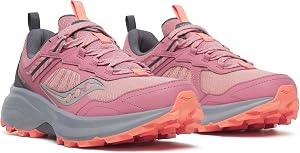
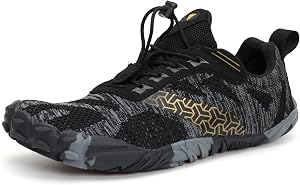
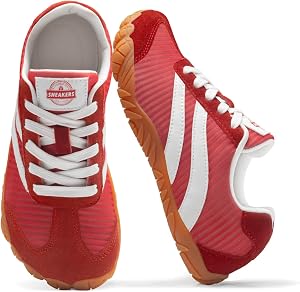
The Fastest Known Time community distinguishes three styles: unsupported (carry everything start to finish), self supported (resupply at stores, caches, or natural water but no human crew), and supported (full crew with pacers). Self supported is by far the most common style, and it places unique demands on a vest that race-day kits do not. You spend most of your hours between resupplies carrying maximum weight, you filter water from streams or springs, and you need to stash everything from a SPOT tracker to a wind shell to spare insoles in pockets that don't bounce.
The wrong vest creates compounding problems. Pockets that sag with weight cause front-load slap that bruises ribs by hour 12. Bladders without good quick-disconnect couplings turn a 90-second refill into a 6-minute fumble. Shoulder strap webbing that abrades a shirt will abrade skin by hour 30. The best hydration vest for self supported FKT attempts solves all three before you even tighten the sternum strap.
Top hydration vests for self supported FKTs in 2026
Salomon ADV Skin 12 — best all-around
The ADV Skin 12 has been the FKT default for five years, and the 2026 revision keeps everything that worked while finally fixing the bottle pocket fray issue. Twelve liters splits across two front 500ml flask pockets, two zippered chest pockets, a sleeve-style back compartment that swallows a 2L bladder plus a packable shell, and bottom dump pockets for trash. The fit hugs the torso almost like a compression shirt, which keeps the load locked on technical downhills. The single weak point: bladder hose routing requires threading through a small loop that gets fiddly in cold conditions. For routes under 60 hours where weight matters more than pure features, this is the pick.
Ultimate Direction Mountain Vest 6.0 — best for technical terrain
UD rebuilt the Mountain Vest from scratch for 2026, and the new chassis with the magnetic chest closure is genuinely better than any previous version. The vest carries 13.4 liters in a layout designed with input from established ultrarunners, which means actual FKT athletes shaped every pocket. Standout features include dual front pole quivers (no more bungeed poles flopping into your knees), trekking pole stash-on-the-fly routing that lets you sheathe poles without stopping, and gel pocket placement you can reach with your mouth on steep climbs. The Mountain Vest carries heavy loads more comfortably than the ADV Skin but loses out slightly on pure flat-ground bounce control.
Nathan Pinnacle 12L — best for hot-weather FKTs
Nathan's Pinnacle is the dark horse of the 2026 lineup. The mesh is more breathable than either Salomon or UD, the asymmetric flask pockets eliminate the right-flask-bounces-more problem most vests have, and the price is roughly $40 below the competition. The trade-off: pocket organization is less refined and the bladder compartment requires unloading the back to insert a fresh bladder. For desert FKTs (Zion Traverse, Grand Canyon R2R2R, Mogollon Rim) where breathability is the limiting factor, this is the smart buy.
Trekking poles: the companion gear self-supported FKTs can't skip
Of the 50 longest established FKT routes tracked in 2026, the vast majority have meaningful vertical gain. Trekking poles aren't optional for serious self supported attempts—they're load-bearing equipment that saves your quads on descents and your achilles on climbs. Your vest's pole quiver only works if your poles fold short enough to stash, deploy fast enough to use mid-stride, and survive being slammed into talus. The three models below are the ones we actually carry on FKT attempts.
| Model | Folded length | Weight (pair) | Grip | Best for |
|---|---|---|---|---|
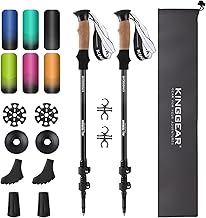
| Nordic Lightweight 7075 Aluminum | ~15 in | ~17 oz | EVA foam | Lowest-cost FKT-grade option |
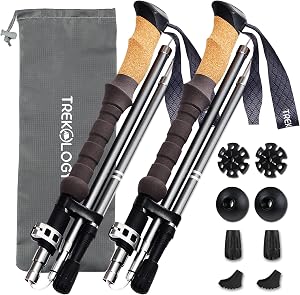
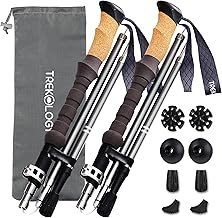
| TREKOLOGY Trek-Z Cork Grip Folding | ~14.5 in | ~19 oz | Natural cork | Long routes with sweat-prone climbs |
| Collapsible Aluminum 2-Pack | ~13 in | ~16 oz | EVA foam | Backup pair / shorter folded stash |
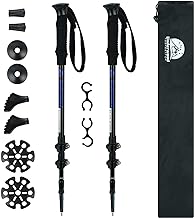
Nordic Lightweight 7075 Aluminum Trekking Poles
The 7075-T6 aluminum tubing is the same alloy used in higher-priced FKT poles from premium brands, but at roughly a quarter of the cost. A folded length of about 15 inches stashes cleanly in the Salomon ADV Skin's diagonal quiver or the UD Mountain Vest's vertical quiver. The EVA foam grip is forgiving on bare hands and the tungsten carbide tips bite well on wet granite. Three-section folding deploys in under four seconds once you've practiced it twice. Check the Nordic 7075 poles on Amazon.
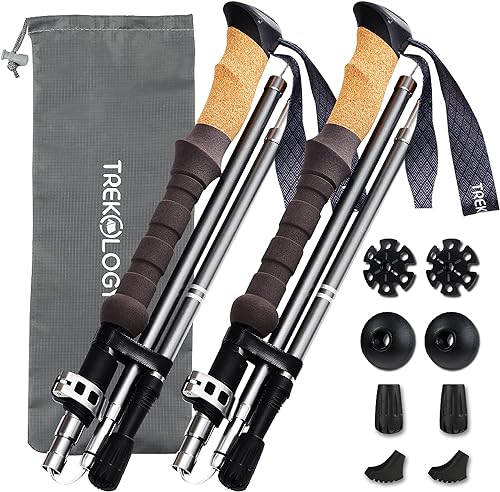
TREKOLOGY Trek-Z Cork Grip Folding Trekking Poles
Cork grips earn their premium on long FKTs. After hour 18 of sweating, foam grips get slick and start blistering the web between thumb and index finger. Cork stays grippier, wicks better, and molds slightly to your hand shape over a season. The Trek-Z folding mechanism uses an internal Kevlar cord—the same architecture as the gold-standard premium Z-folding poles. They weigh about 19 oz per pair, roughly 2 oz heavier than the cheapest options but well below the 24+ oz of older telescoping designs. See the TREKOLOGY Trek-Z on Amazon.
Collapsible Aluminum Trekking Poles, 2-Pack
Sometimes the right move is owning two pole sets: one for the attempt, one as backup. FKT attempts get scrubbed when a pole tip snaps off mid-route, and re-attempting a route can cost weeks of training peak. This 2-pack ships two complete pairs at a price below most single premium poles. Useful for team FKTs where you need spare gear for a partner, multi-day attempts where you stash a backup at a cache, or training pairs you don't worry about beating up on shoulder-season ice. View the 2-Pack on Amazon.
Fit, sizing, and chafe prevention for 24+ hour vests
The single biggest mistake first-time FKT attempters make is buying their normal race vest size. A 50K-grade fit creates raw spots by hour 14. For self supported attempts, size up half a size from your race-day vest if half-sizes are offered, or move to the larger size when there's any ambiguity. Why: you'll be wearing more layers (wind shell, mid-layer, headlamp strap), carrying more weight (which compresses the foam padding), and sweating through more salt cycles (which abrades anywhere fabric meets skin).
Apply anti-chafe balm before the start everywhere the vest contacts skin: shoulders, sternum, lower back, armpits, and especially the spot where the bladder hose clip routes across your collarbone. Reapply every 6-8 hours from a tube stashed in a front pocket. For armpit chafe specifically, the underarm seam of your shirt matters more than the vest itself—merino or Polartec Power Dry beats cotton or generic polyester by a wide margin. See our ultra-distance chafe prevention guide for the full system, and the self-supported FKT gear checklist for everything you'd otherwise forget.
Hydration strategy: bladder vs flasks vs hybrid
Three configurations work for self supported FKTs in 2026:
Full bladder (2L back + empty flasks): Best for cold-weather routes or routes with very few water sources. Maximum carry capacity, easiest to top off at a single stop. Downsides: harder to monitor remaining volume, slower to refill if your bladder requires removing pack contents.
Flasks only (4-6 x 500ml): Best for hot routes with frequent water (creek-rich forests, alpine streams every five miles). Lightest, most modular, easiest to fill from a stream filter. Downsides: lower total capacity (typically 1.5-3L max), more handling per drinking cycle.
Hybrid (1L back + 2x500ml front): The configuration most experienced FKT runners settle on. Front flasks are your active hydration—what you drink first and refill at every crossing. The back liter is reserve, sipped only between sources or on hot afternoons. This matches the volume of a 2L pure bladder while giving you instant volume-check by glancing at the front flasks.
Packing your vest the night before
Run a dry-pack the night before to verify everything fits without overloading any single pocket. The right load distribution puts heavy items (battery banks, food, extra flasks) close to your back, between the shoulder blades and the small of your back. Light items (shells, gloves, emergency blanket) go in the lower dump pockets and the very top of the back compartment. Anything you'll need without stopping (gels, salt tabs, phone, lip balm, headlamp at dusk) lives in the front chest pockets within fingertip reach.
For pacing notes, the route map, and the emergency bivvy, use ziplock bags inside pockets rather than trusting "water resistant" zippers in actual rain. Four-mil freezer-grade bags work; the cheap sandwich bags fail after eight hours of sweat soak. See our trail headlamp roundup for night-travel picks that pair well with these vests.
Frequently Asked Questions
What is the minimum vest capacity for a self supported FKT under 50 miles?
For self supported attempts under 50 miles with water sources every 8-12 miles, a 6-8 liter vest is the sweet spot. You're carrying 1-1.5L of water, 6-8 hours of calories, a wind shell, a headlamp if night travel is possible, a phone, and emergency gear. Anything smaller forces compromises on safety gear; anything larger wastes shoulder real estate on empty volume that just bounces.
Can I use a regular running vest for an unsupported FKT?
For unsupported attempts (carry everything from start to finish, no resupply), most racing vests are too small. Plan on 12-20 liters depending on route length. The Salomon ADV Skin 12 is the floor; UD's Fastpack 20 or comparable 22L fastpacking vests are more appropriate for routes over 24 hours unsupported. The math is brutal: you're carrying 3-4L of water for desert sections, all your food, plus mandatory safety gear with zero opportunity to lighten as you go.
How do I attach trekking poles to a hydration vest on the move?
Modern vests use one of three pole-stash systems. Diagonal quivers (Salomon, Nathan) loop the pole tips into a low hip pocket and the grips into a bungee on the opposite shoulder—fast to stash but the diagonal carry can poke the side of the knee on tall runners. Vertical quivers (Ultimate Direction Mountain Vest 6.0, recent Salomon S/Lab models) keep both poles parallel along your spine—slower to stash but no knee interference. Side-mounted quivers on older models are obsolete for FKT use; skip them.
Do I need a filter or can I drink natural water on a self supported FKT?
Always carry filtration. Even pristine-looking alpine streams can carry giardia from upstream cattle grazing, beaver activity, or other runners' dropouts. The Sawyer Squeeze fits in a side pocket of every vest mentioned above and adds about 3 oz. The Katadyn BeFree weighs less but clogs faster in silty water. For desert FKTs (Grand Canyon, Zion), Aquamira drops are the lightest backup if your filter freezes overnight or clogs at a critical source.
How much should a hydration vest weigh fully loaded for a 24-hour FKT?
For a typical 24-hour self supported attempt, target a fully-loaded starting weight of 8-12 lbs including 2L of water. Above 14 lbs and your stride starts breaking down by hour six; below 7 lbs and you've probably skipped mandatory safety gear. Rough breakdown: 4.4 lbs water, 1.5 lbs vest empty, 2 lbs food, 1 lb electronics (phone, SPOT, battery), 1 lb safety gear (shell, gloves, foil blanket, first aid). Anything else you bring should justify its weight against that floor.
Will a hydration vest replace a running belt for shorter FKTs?
For FKTs under six hours where you'd only carry 500ml-1L of water and a few gels, a quality running belt with bottle slots is lighter and cooler than a vest. The threshold flips above six hours: the vest's load distribution becomes worth its slightly higher heat retention. Most runners attempting FKTs in the 4-8 hour range own both and pick by route specifics—shaded forest with frequent water favors the belt, exposed ridges favor the vest.
Are women-specific FKT vests worth the upcharge?
Yes for fit, not for features. Salomon's ADV Skin W series and UD's Mountain Vesta use the same pocket layout and capacity as the unisex versions but with shoulder strap angles and chest closure positions designed around female anatomy. The difference matters most at the sternum strap—on a vest sized for male torso geometry, the strap rides directly across the chest, which is painful at race effort. The W versions reroute the strap below or above. If you're female-bodied and pushing FKT efforts, get the W. The features are identical.
Key Takeaways
- Choosing the right best hydration vest for self supported FKT attempts means matching capacity and output ports to your actual devices
- Always check actual watt-hours (Wh), not just watts — runtime depends on Wh, not peak output
- Also covers: FKT hydration vest large capacity
- Also covers: unsupported fastest known time vest
- Also covers: high volume running vest for FKT
- Compare price-per-Wh across models to find the best value for your budget