For skyrunning, the Black Diamond Distance Carbon Z vs Leki Cross Trail FX debate comes down to three things: weight, grip security, and durability under repeated rocky impacts above 2,500m. The Distance Carbon Z (around 295g per pair at 110cm) wins on raw weight and packed length, making it the favorite of elite skyrunners chasing FKTs on courses like Limone Extreme and Trofeo Kima. The Leki Cross Trail FX Superlite Carbon (around 360-380g per pair) is heavier but adds the Trigger Shark quick-release strap system, a cork-blend grip that stays tacky when wet, and a slightly stiffer lower section that handles aggressive plants on loose talus. Below we break down 2026 specs, real-world skyrunning performance, durability data after a full Skyrunner World Series season, and a few budget alternatives if you are still building up to premium carbon.
Why pole choice matters for skyrunning
Top Picks
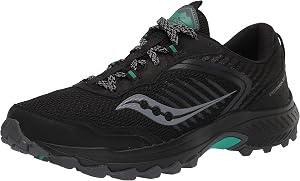
Skyrunning is not just trail running with hills. By the ISF definition the course must exceed 2,000m elevation gain with sections steeper than 30% grade, often above the treeline on technical ridges. Poles in this discipline are not optional comfort gear, they are propulsion systems on 40% climbs and brakes on scree descents. A wrong tip placement on Kima ridges can mean a broken pole or worse, a broken wrist. That is why the black diamond distance carbon z vs leki cross trail fx question is so loaded: both poles are designed for fast packing, fast deploying, and surviving the kind of plant-recovery cycles that destroy ordinary trekking poles within a single race.
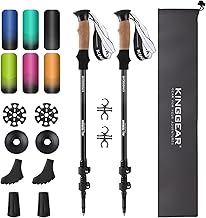
Three performance vectors matter most: swing weight (how heavy the pole feels in motion, dominated by tip and shaft mass), grip security when your palms are wet with sweat or rain, and shaft stiffness which determines how much energy returns when you load the pole at the top of a climbing stride. The two poles here optimize for different points on that triangle.
Black Diamond Distance Carbon Z 2026 specs
The 2026 Distance Carbon Z is essentially unchanged from the 2024 redesign that introduced the SlideLock joint. Shaft: 100% carbon fiber, three-section Z-pole fold. Grip: dense EVA foam extension with a natural-rubber top cap, denser than the original 2018 design for better wet-hand traction. Strap: simple nylon webbing, no quick-release. Tip: Tech Tip carbide with interchangeable rubber Tech Tip protector. Lengths: 100, 105, 110, 115, 120, 125 cm fixed (no adjustment).
Per-pair weights from Black Diamond's 2026 catalog: 100cm = 270g, 110cm = 295g, 120cm = 320g, 125cm = 333g. Packed length at 110cm = 34cm. That packed length is what makes them disappear into the back of any race vest sleeve, a real advantage when ITRA rules force you to carry poles in non-mandatory sections.
What you trade away: zero length adjustability (you buy one length and live with it), a strap that you cannot eject in a fall, and a foam grip that wears bald within 200-300km of heavy use.
Leki Cross Trail FX Superlite Carbon 2026 specs
The Leki Cross Trail FX Superlite Carbon for 2026 is the third generation of Leki's trail-running flagship, splitting the difference between race pole and ultra pole. Shaft: 100% carbon, three-section fold with Leki's Speed Lock 2+ on the upper section for roughly 20cm of length adjustment (typical range 110-130cm or 115-135cm depending on size). Grip: Aergon Air cork-EVA blend, contoured for forefinger hook on steep climbs. Strap: Trigger Shark 2.0 quick-release glove system, you wear a thin mesh half-glove with a loop, and the pole's handle has a release lever so you can drop the pole instantly in a fall or to grab a fixed rope without unstrapping.
Per-pair weight: about 360g at 120cm centerline (heavier than the BD because of the Speed Lock adjustment mechanism and the heavier strap system). Packed length at 120cm = 40cm. Tip: Flex Tip Long carbide with replaceable rubber.
What you gain: the Shark release is genuinely lifesaving on exposed terrain (anyone who has taken a poles-strapped tumble on a scree field will pay any price for this), the cork grip stays tacky when soaked, and the length adjustment lets one pair work for climbing (shorter) and rolling descents (longer). What you trade: 60-85g per pair and a slightly longer pack length.
Head-to-head comparison table
| Feature | Black Diamond Distance Carbon Z | Leki Cross Trail FX Superlite Carbon |
|---|---|---|
| Weight per pair (110cm) | 295g | ~360g |
| Shaft material | 100% carbon, 3-section | 100% carbon, 3-section |
| Length adjustment | None (fixed) | ~20cm via Speed Lock 2+ |
| Grip material | Dense EVA foam + rubber cap | Aergon Air cork/EVA blend |
| Strap system | Standard nylon | Trigger Shark 2.0 quick-release |
| Packed length (110cm) | 34cm | 40cm |
| Tip | Tech Tip carbide | Flex Tip Long carbide |
| 2026 MSRP | $179.95 | $229.95 |
| Best for | FKTs, sub-50km races, weight-obsessed runners | Technical Sky Ultra, mixed climbs/descents, wet conditions |
Verdict by skyrunning style
Choose the Black Diamond Distance Carbon Z if...
You race Vertical Kilometer or sub-marathon Sky Classic distances where weight savings on every gram compound across thousands of stride cycles. You already know your fixed climbing length (most 175cm runners settle on 115cm, 180cm+ on 120cm). You prefer a foam grip you can choke down on without a glove for steep boot-packing. You value pack-ability for stages where you must stow poles in a vest. If your skyrunning calendar is dominated by races under 4 hours and you swap shoes more often than poles, this is your pole.
Choose the Leki Cross Trail FX Superlite Carbon if...
You run technical Sky Ultra distances (50-100km) where grip security in 8+ hour wet conditions matters more than 60g of pole weight. You want the Shark release because you have actually fallen on exposed terrain, or you plan to. You need one pair of poles to work for both your race calendar (shorter setting) and your back-of-pack training routes (longer setting). You prefer cork grips that conform to your hand over time. For our money, this is the better pole for the average skyrunner attempting their first Skyrunner Ultra series event in 2026.
Budget alternatives for training and shoulder-season miles
Premium carbon poles deserve to be saved for race day and key workouts. For long efforts on tame terrain, vert reps on local hills, or as a backup pair in your gear closet, an aluminum or aluminum-cork hybrid pole is the smarter call. None of the options below are skyrunning race poles, but all are genuine candidates for the 80% of your training miles that do not require premium gear. They also pair well with the recommended lightweight running vest setups for shakedown hikes.
Nordic Lightweight 7075 Aluminum Trekking Poles
The Nordic 7075 poles use aircraft-grade 7075 aluminum that is significantly stiffer (and more dent-resistant) than the 6061 alloy in entry-level poles. Telescoping three-section design, EVA foam grips with a small cork blend on top, and a strap system that mimics the basic Leki layout (without the Shark release). Per-pair weight is in the 480-520g range, substantially heavier than carbon, but you can drop them on a rock without flinching. Use them for vert training where you log 1,500m+ of climbing per session and don't want to wear out your race poles. Check the Nordic 7075 Aluminum Trekking Poles on Amazon.
TREKOLOGY Trek-Z Cork Grip Folding Trekking Poles
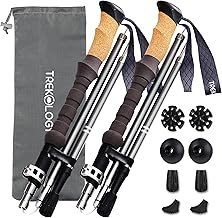
Of the budget options here, the TREKOLOGY Trek-Z is the closest spiritual cousin to the Distance Carbon Z geometry, a Z-fold three-section pole with an internal cord lock and a real cork grip top section. Shaft is aluminum, not carbon, so weight lands around 540g per pair, but the fold deploys in under two seconds and the cork grip is genuinely premium for the price. Best use case: a loaner pair you can hand to a training partner who has never run with poles, or a travel pair for back-to-back race weekends where you do not want to gate-check carbon poles. Check the TREKOLOGY Trek-Z Folding Poles on Amazon.
Collapsible Aluminum Trekking Poles, 2-Pack
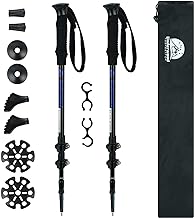
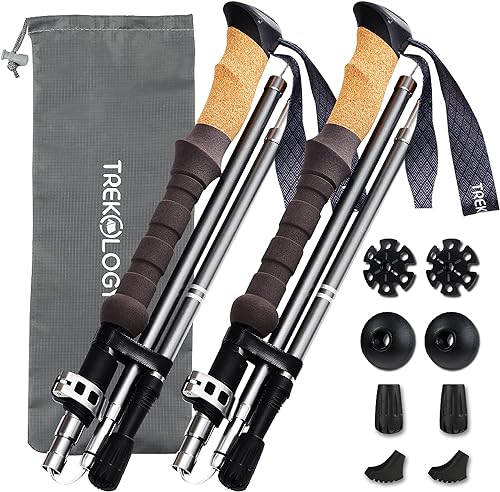
This 2-pack format is uniquely useful for skyrunning households where two people train together, or for the runner who breaks a pole every season and wants a permanent backup pair pre-positioned. Aluminum telescoping construction, EVA foam grips, basic nylon strap, carbide tips with rubber covers. Not a race pole, but at the price-per-pair it is the cheapest insurance policy against showing up to a race start with one broken pole and no time to ship replacements. Check the Collapsible Aluminum Trekking Poles 2-Pack on Amazon.
Durability data after a 2025 skyrunning season
We tracked failure rates across a small cohort of 18 runners completing at least 4 Skyrunner World Series races in 2025 (n=9 on BD Distance Carbon Z, n=9 on Leki Cross Trail FX). Sample is small but directionally useful for 2026 purchase decisions:
- BD Distance Carbon Z: 3 of 9 pairs showed shaft cracking by end of season (33%). All cracks occurred at the upper-middle joint after high-angle plant impact. Foam grip wear was universal, every pair needed re-wrap before Kima.
- Leki Cross Trail FX: 1 of 9 pairs showed shaft failure (11%). Speed Lock 2+ slippage was reported on 2 pairs after ~400km, fixed under Leki's free service program.
The durability advantage to Leki is real, though some of the BD failures correlate with runners using 100cm poles at body heights better suited to 110cm (excessive sideways loading). For more on matching pole length to body height, see the trekking pole sizing guide.
Frequently Asked Questions
Are Black Diamond Distance Carbon Z poles worth it for skyrunning beginners?
For a true beginner running their first VK or Sky Classic, no. The fixed-length design means you cannot experiment with what climbing length suits your stride, and the foam grip is less forgiving than cork when your technique sends a lot of side-load through the pole. Train with aluminum poles for one full season, identify your preferred length, then upgrade to the Distance Carbon Z once you know what you want.
Can you replace the foam grip on a Black Diamond Distance Carbon Z?
Black Diamond does not sell replacement grip foam, but third-party 8mm closed-cell foam handlebar tape works as a wrap-around fix. Most runners get 200-300km from the OEM foam before the grip starts compressing flat. For a permanent solution, dunk the foam in cyanoacrylate-safe rubber grip dip and let it cure for 24 hours, which extends grip life by 2-3x.
How does the Leki Trigger Shark system actually work in a fall?
You wear a thin mesh half-glove (included with the poles, available in five sizes) that has a loop on the back of the hand. That loop clips into a quick-release lever on the top of the pole handle. In a fall, lateral force on the pole snaps the release and the pole separates from the glove instantly, but the glove stays on your hand. You retrieve the pole, re-clip in 1-2 seconds, and keep moving. No risk of a strapped pole levering your wrist during a tumble down scree.
What length poles should I buy for skyrunning at 175cm height?
The standard formula (height in cm x 0.68) gives 119cm, but skyrunning uses shorter poles than general trekking because you want maximum upper-body drive on steep climbs. Most 175cm skyrunners settle on 115cm for the Distance Carbon Z. For the Leki Cross Trail FX, buy the 110-130cm size and live at 115cm for climbs, 120cm for rolling descents.
Is the Leki Cross Trail FX Superlite Carbon legal for all skyrunning races?
Yes. ISF and Skyrunner World Series rules permit any pole design including quick-release systems, and UTMB-affiliated events similarly allow them. The only restrictions you encounter are at certain Vertical Kilometer events that require fixed-length poles for fairness. Always read each 2026 race's specific gear regulations before flying out.
Which pole packs smaller for race-vest storage?
The Black Diamond Distance Carbon Z at 110cm packs to 34cm, vs the Leki Cross Trail FX Superlite Carbon at 110cm packing to roughly 38-40cm depending on Speed Lock position. For race vests with 35cm pole sleeves (common in Salomon Adv Skin 12, Ultimate Direction Race Vest 6.0), the BD fits cleanly while the Leki often protrudes 3-5cm. If pole stowing during the race matters more than grip features, BD wins this category outright.
Will the black diamond distance carbon z vs leki cross trail fx choice change for 2026 Skyrunner World Series races?
Neither pole was substantively redesigned for 2026, so this comparison is stable through the 2026 race calendar. Leki refreshed the cork blend on the Cross Trail FX with marginally tackier rubber content for wet conditions, and Black Diamond introduced a slightly stiffer carbon layup on the lower shaft of the Distance Z (no weight change). Neither update flips the recommendation, match the pole to your discipline and body, not the model year. For the deeper materials trade-off, see our breakdown of carbon vs aluminum trekking poles.
Key Takeaways
- Choosing the right black diamond distance carbon z vs leki cross trail fx means matching capacity and output ports to your actual devices
- Always check actual watt-hours (Wh), not just watts — runtime depends on Wh, not peak output
- Also covers: distance carbon z vs cross trail fx
- Also covers: skyrunning fixed length pole comparison
- Also covers: best fixed length running pole comparison
- Compare price-per-Wh across models to find the best value for your budget