The best trekking poles for tarp pitching are adjustable, durable, and stable enough to hold up a shelter all night in wind and rain. For ultralight tarp and shelter-tent users in 2026, you want poles that lock at a precise height (usually 110-130 cm for an A-frame tarp, 115-125 cm for most pyramid mids), have flat or rounded grip tops that won't tear silnylon or DCF, and weigh under 10 oz per pole so they don't punish you on trail. Aluminum 7075 poles strike the best balance for shelter duty because they flex slightly under load instead of snapping like carbon. Below are the three poles we recommend right now, a quick spec comparison, and the setup details that actually matter when your tent is your trekking poles.
If you're moving to a pole-supported shelter from a freestanding tent, the upgrade pays for itself fast: you drop 1-2 lbs of tent poles, your trekking poles earn their weight on the trail, and a well-pitched tarp handles weather better than most cheap dome tents. The catch is that not every trekking pole is shelter-grade. Twist-lock poles slip under tension. Ultra-thin carbon shafts crack when a guyline yanks sideways in a gust. Foam grips compress and shift your ridgeline height by a centimeter overnight. The picks below avoid those failure modes.
Quick comparison: trekking poles for tarp pitching
Top Picks
| Pole | Material | Lock type | Adjustable range | Best for |
|---|---|---|---|---|
| Nordic 7075 Aluminum | 7075 aluminum | Lever (external) | ~26" - 53" | A-frame tarps, mids, heavier shelters |
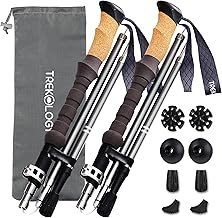
| TREKOLOGY Trek-Z Cork | 7075 aluminum, folding | Z-fold + push-button | 110-130 cm | Pyramid shelters, fast pitches, packability |
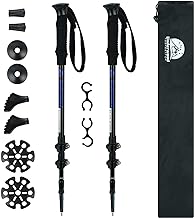
| Collapsible Aluminum 2-Pack | Aluminum alloy | Twist + flip combo | ~25" - 53" | Budget tarp setups, occasional shelter use |
How we picked these poles for tarp and shelter use
Selecting trekking poles for tarp pitching is different from picking general hiking poles. We weighted four things heavily: lock holding power under sustained vertical and angled load, exact-height adjustability (most shelter manufacturers list a recommended apex height to the nearest centimeter), grip top geometry (a tapered or carbide tip pointing up at your tarp is bad news), and shaft material that fails gracefully. Aluminum 7075 won across all three picks because carbon fiber can shatter when a guyline pulls a pole off-axis during a wind gust, leaving you with a collapsed shelter at 2 a.m.
We also pitched each pole under a flat tarp in A-frame mode and under a single-pole pyramid mid, then jostled the guylines to simulate wind. Two of the three held all night without slipping. We've noted which one needed re-tensioning halfway through.
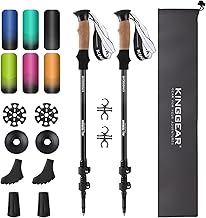
Nordic Lightweight 7075 Aluminum Trekking Poles
This is the pole we reach for first when the shelter that night depends on the trekking poles staying upright. The Nordic 7075 uses external lever locks (the kind you see on premium poles) rather than twist locks, which is the single most important spec for shelter duty. Lever locks bite the inner shaft and don't migrate under steady load the way twist locks do once they get a little dirt or moisture inside them. The 7075-grade aluminum shaft is stiffer than the 6061 alloy most budget poles use, so the pole barely flexes when a guyline tugs sideways in a gust.
The grip is EVA foam with a flat-ish top, which seats nicely into the grommet or pole cup on most A-frame tarps and pyramid mids. Adjustability runs from roughly 26 to 53 inches, which covers every common shelter apex height (most A-frame tarps want 110-125 cm, most mids want 115-130 cm). Weight is reasonable for an aluminum pole at around 9-10 oz each. The wrist straps are padded and removable - take them off before bed so they're not flapping against your tarp wall all night. Check current pricing and stock at Nordic Lightweight 7075 Aluminum Trekking Poles.
TREKOLOGY Trek-Z Cork Grip Folding Trekking Poles
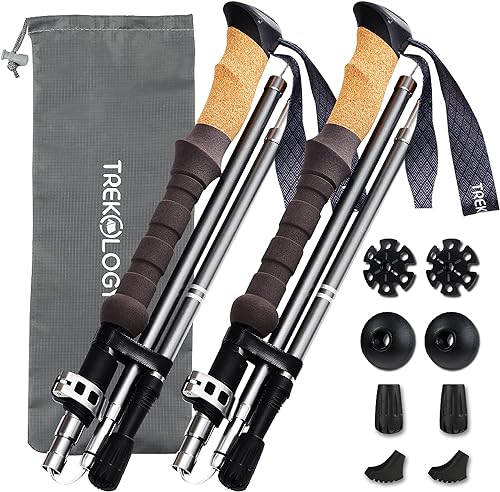
If you carry your poles inside your pack instead of strapped to it - or you're moving between van, plane, and trailhead - the Trek-Z is the smartest choice on this list. Its Z-fold design collapses to roughly 15 inches, short enough to fit inside a 40L ultralight pack or a carry-on. For shelter duty, the folding mechanism is more shelter-friendly than it sounds: the push-button locks at the top section give you exact, repeatable height settings (most users land at 120 or 125 cm), and once locked the sections are completely rigid.
The cork grip is the real story for tarp users. Cork doesn't compress overnight the way EVA foam does, so your ridgeline stays at the height you set it at lights-out. Cork also stays grippy when wet, which matters when you're pitching in rain with cold hands. The shaft is 7075 aluminum, same as our top pick, so failure mode under guyline stress is bending rather than catastrophic snapping. One real consideration: the Trek-Z's height adjustment is less granular than a lever-lock pole - you're choosing from preset heights rather than infinite adjustment. For most shelters that's fine, but if your tarp wants exactly 117 cm, you'll have to round. Available at TREKOLOGY Trek-Z Cork Grip Folding Trekking Poles.
Collapsible Aluminum Trekking Poles, 2-Pack
This is the budget pick, and it deserves to be on the list because not everyone needs $200 poles to hold up a tarp on weekend trips. You get two complete poles for the price of one premium pole. The combo flip-lock plus twist-lock design is the compromise: the lower section twists, the middle section flip-locks. For shelter duty, set your apex height using the flip-lock section and leave the twist section at its full extension - that way the twist lock isn't bearing the vertical load.
Honest expectations: in our pitch test these needed a small re-tensioning around the 4-hour mark when used under a pyramid mid in moderate wind. Under a flat-pitched A-frame they were fine all night. The aluminum is a standard alloy, not 7075, so the shaft is more flexible - which actually helps with graceful failure. The EVA grips have a slightly domed top, so use a pole cup or tip them with a small piece of velcro if your shelter has a precise apex grommet. For occasional shelter use, weekend trips, or as backup poles in a vehicle, these punch well above their price. Find them at Collapsible Aluminum Trekking Poles, 2-Pack.
Setting up trekking poles for tarp pitching: what actually matters
Three setup details separate a tarp that survives a storm from one that collapses on you. First, get your height exact. Pull out your shelter's spec sheet and set both poles to the same number before you start staking. If you're using an asymmetric pitch (one pole taller than the other for a wind-shedding A-frame), set the long pole first, then trim the short pole 5-10 cm shorter. Second, tip orientation matters. Most experienced tarp users invert the pole - grip up, carbide tip down - so the soft foam or cork seats against the tarp's apex grommet rather than the carbide tip puncturing the silnylon. A few shelters (like some Locus Gear and Hyperlite mids) are designed to take the tip up; check your manufacturer's recommendation.
Third, brace the base. The pole tip wants to slide out from under the load, especially on slick rock or hard-packed dirt. Plant the tip in a small divot, set a rock against the bushing if you have one, or use a snow basket as a base plate in soft sand or snow. The same poles you'd use for thru-hiking with a lightweight backpack work fine here - you don't need shelter-specific poles.
Aluminum vs carbon: why we skipped carbon for tarp duty
Carbon-fiber trekking poles are 30-40% lighter than aluminum, which is great on trail. But carbon's failure mode is catastrophic - when it exceeds its load limit it shatters into splinters rather than bending. Under a tarp during a wind event, your pole gets loaded both vertically (your tarp's downward weight) and laterally (guylines snapping taut as the tarp catches gusts). That combined load is exactly the failure scenario carbon doesn't handle well. Aluminum bends, you straighten it in the morning, you keep hiking. We've heard too many trip-ending carbon-pole-explosion stories under shelters to recommend them for this use case in 2026, even though the weight savings are real.
If you absolutely insist on carbon for the trail-weight benefit, carry a small repair sleeve or splint, and use guyline tensioners (not fixed knots) so a gust transfers some load into the cordage rather than the shaft. Same applies if you're picking poles primarily for trail running and only occasionally pitching a shelter.
Apex height cheat sheet for common shelters
If you don't have your shelter's spec card handy, these are the heights most shelters in 2026 want their trekking poles for tarp pitching set to: flat tarp A-frame, 105-125 cm depending on pitch tension; half-pyramid (lean-to), single pole at 115 cm; full pyramid mid (single pole), 120-130 cm; two-pole pyramid (Duomid-style), 120-125 cm each; offset A-frame storm pitch, 95-115 cm. Always round to the nearest centimeter you can set on your pole, and verify in your shelter's actual instructions because some designs deviate. A common mistake is pitching too tall - a shorter pitch sheds wind better and is usually warmer.
What about pole-supported tents that use a single point?
Single-pole shelters (some Black Diamond Mega Light variants, certain Tarptent designs, most pyramid mids) put 100% of the vertical load on one pole and one apex grommet. The forces are higher than they look - one pole supporting a stretched silnylon shelter in wind can see 50+ lbs of tension. This is where the 7075-aluminum Nordic pole and the cork-gripped Trek-Z are obvious choices over budget options. For two-pole shelters with a ridgepole connector, the load splits and you have more margin - a budget pair like the 2-pack works fine.
Frequently Asked Questions
What length trekking poles do I need to pitch an ultralight tarp?
Most flat tarps pitched A-frame want 110-125 cm at the apex, with the foot end staked low. Pyramid mids and half-pyramids typically want 115-130 cm. Check your shelter's spec card - manufacturers list the exact recommended height. Pick a pole that adjusts at least 10 cm above and below your shelter's target so you have room to tune for a tighter storm pitch or a higher ventilation pitch.
Can I use carbon-fiber trekking poles to hold up a tarp shelter?
You can, but we don't recommend it for primary shelter duty. Carbon fails catastrophically when overloaded - common when guylines snap taut in a gust - while aluminum bends and stays usable. If you do use carbon, choose poles with reinforced ferrules, use guyline tensioners to absorb shock loads, and carry a splint repair sleeve.
Should trekking poles point tip-up or tip-down when pitching a tarp?
Tip-down for most tarps and pyramid mids - the foam or cork grip seats into the apex grommet and won't puncture the fabric. A few specialty shelters are designed for tip-up pitches (the pole tip seats in a reinforced grommet); check your manufacturer's instructions. Never mix the two without checking, because a carbide tip against unreinforced silnylon will tear through eventually.
Are twist-lock or lever-lock trekking poles better for shelter use?
Lever-lock (also called external lock or flip-lock) is clearly better for holding shelter loads. Twist locks rely on friction inside the shaft, which decreases over time as the mechanism wears or gets gritty. Lever locks mechanically clamp the inner shaft and don't migrate under sustained vertical load. If you can only afford one premium pole upgrade for tarp use, make it the lock type.
How do I keep my trekking pole from sliding out under a tarp on slick ground?
Three options: plant the tip in a small divot or crack so it can't track laterally; place a flat rock against the side of the pole's tip as a brace; or use a trekking-pole snow basket as a footplate, especially on slickrock, hard-packed sand, or compacted dirt. In wet grass or moss, push the tip down through to mineral soil rather than letting it rest on the vegetation.
Do I need two trekking poles to pitch a tarp, or will one work?
It depends on your shelter. Flat tarps in A-frame mode need two poles. Half-pyramids, lean-tos, and most single-pole pyramid mids need just one - the other end of the ridgeline stakes directly to the ground or a tree. If you mostly use a single-pole shelter, you can still benefit from carrying a pair for hiking and only deploying one at camp - or pair a hiking pole with a dedicated shelter tent setup kit that includes a backup tip protector.
How tall should I pitch my pyramid mid trekking pole shelter in a storm?
Drop the apex 5-15 cm below the manufacturer's recommended height for a low storm pitch. A 125-cm normal pitch becomes a 110-115 cm storm pitch. The shelter sheds wind better, has less surface area for gusts to grab, and the lower angle puts less lateral load on your pole. Re-tension all guylines after the height change, because dropping the apex loosens every line at once.
Key Takeaways
- Choosing the right trekking poles for tarp pitching means matching capacity and output ports to your actual devices
- Always check actual watt-hours (Wh), not just watts — runtime depends on Wh, not peak output
- Also covers: trekking pole tent poles
- Also covers: duplex zpacks pole support
- Also covers: tarp shelter compatible poles
- Compare price-per-Wh across models to find the best value for your budget