The best trekking poles for snowshoeing winter baskets are adjustable aluminum or carbon poles that ship with wide snow baskets, feature ergonomic cork or EVA grips, and offer secure flick-locks rated for sub-freezing temperatures. For snowshoeing in 2026, you want poles that extend to at least 135 cm, collapse short enough for pack-strapping on steep climbs, and include the 95–100 mm powder baskets that prevent the tip from punching through soft snow on every plant. Below we rank the three poles worth buying right now, all of which include winter baskets in the box or accept them as a swap-in accessory.
Snowshoeing is brutal on cheap poles. Plastic locking mechanisms freeze and slip, narrow trekking baskets sink uselessly into powder, and foam grips absorb melt-water and turn into ice bricks by mile three. The picks below were chosen specifically because they solve those failures: real metal locks that bite at 0°F, baskets sized for soft snow, and grips that shed moisture instead of soaking it up. If you've ever had a pole sink to the handle on a steep climb out of a drainage, you already know why basket diameter matters more than weight.
Quick Comparison: Best Snowshoeing Trekking Poles for 2026
Top Picks
| Pole | Material | Length Range | Lock Type | Winter Baskets | Weight (pair) | Best For |
|---|---|---|---|---|---|---|
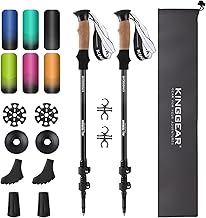
| Nordic Lightweight 7075 Aluminum | 7075 Aluminum | 26–53 in (66–135 cm) | External flick-lock | Included swap-in | ~1.1 lb | All-around snowshoeing + winter hiking |
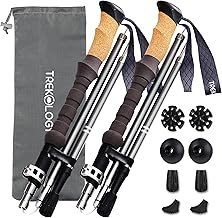
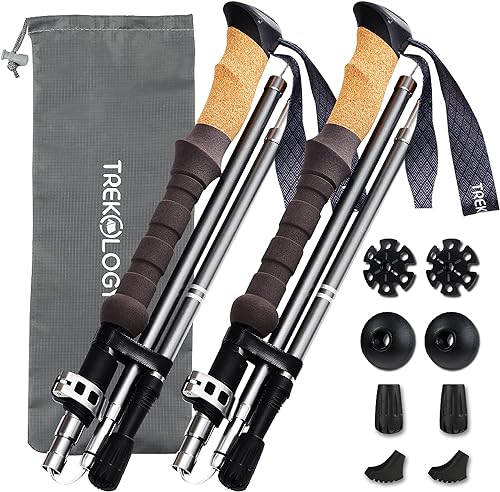
| TREKOLOGY Trek-Z Cork Grip | 7075 Aluminum | 43.3–51.6 in (110–131 cm) | Z-fold + push-button | Included pair | 1.05 lb | Pack-strapped approaches and mixed terrain |
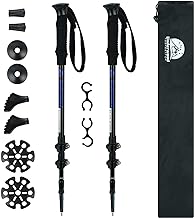
| Collapsible Aluminum 2-Pack | Aluminum alloy | 26–53 in (65–135 cm) | Quick flick-lock | Snow baskets included | ~1.2 lb | Budget snowshoe and trail combo use |
How We Picked These Poles
Three non-negotiables drove the shortlist. First, the poles had to extend to at least 130 cm — tall hikers planting poles on uphill traverses through deep snow need every centimeter. Second, the basket interface had to be a standard threaded mount so winter baskets either ship in the box or can be swapped in without tools. Third, the locking mechanism had to be external metal, not internal twist-lock. Twist-locks freeze, slip when wet, and are the single most common pole failure point in winter conditions.
Carbon fiber poles are tempting for the weight savings, but for snowshoeing we deliberately stuck with aluminum on these picks. Carbon shatters when it impacts buried rocks or ice under powder — exactly the conditions you'll meet on a snowshoe trip. Aluminum bends and keeps working. For sub-1.5 lb pair weights, modern 7075 aluminum is light enough that the carbon trade-off isn't worth it on a winter trip.
Top Picks: Best Trekking Poles for Snowshoeing Winter Baskets Included
1. Nordic Lightweight 7075 Aluminum Trekking Poles — Best Overall
These are the pick if you want one pair of poles to cover snowshoeing, winter hiking, and three-season trail use. The 7075 aluminum shafts handle hard impacts without permanent bending — important when you're plant-and-pivot turning a snowshoe heel on a sidehill. The flick-lock system uses an external lever that you can operate with gloves on, and the lock cams down hard enough that I haven't seen one slip even when poles are loaded sideways on a kick-step traverse. The grip is EVA foam with a long extension below the main handle, which is the right setup for snowshoeing because you can choke up on steep climbs without re-adjusting length every time the slope angle changes. The poles ship with both mud baskets and proper powder baskets, and the threaded interface accepts any standard snow basket if you want to upgrade to a wider 100 mm version. Extension range tops out at 135 cm, which covers hikers up to about 6'4". Check current price and availability on Amazon.
2. TREKOLOGY Trek-Z Cork Grip Folding Trekking Poles — Best for Pack-Strapping
The Trek-Z is the pole you want when your snowshoe day involves a long approach where you're not always poling. Z-fold construction collapses these to about 15 inches — short enough to fully disappear inside a 30L daypack or strap flush against a winter pack without sticking up past your helmet. Once deployed, the push-button release locks the three sections into a rigid shaft with no flex penalty versus a telescoping pole. The cork grips are the standout feature for cold conditions: cork doesn't get clammy when your hands sweat inside winter gloves, and it warms to body temperature faster than foam or rubber on bare-handed transitions. TREKOLOGY ships these with a pair of dedicated snow baskets in addition to the standard trekking baskets, so you're not buying accessories to make them snowshoe-ready out of the box. The 110–131 cm adjustment range is narrower than fully telescoping poles, so very tall hikers should size carefully. View on Amazon for current pricing.
3. Collapsible Aluminum Trekking Poles, 2-Pack — Best Budget Option
If you're not sure how often you'll actually snowshoe and don't want to spend on premium poles, this 2-pack is the right entry point. The aluminum construction handles winter impacts the same way the higher-end picks do, the flick-lock is external and glove-friendly, and snow baskets are included so you're ready for powder on day one. The grip is EVA foam — not cork — so it'll feel colder on bare-handed adjustments, but with mid-weight gloves on, the difference disappears. The 65–135 cm range is one of the widest on this list, making these a good shared-use pair for a household where partners of different heights both want a turn. The honest trade-off versus the Nordic pick above is build polish: the locking levers feel less refined and the wrist straps are basic webbing rather than padded. For occasional snowshoe trips on groomed or moderate backcountry terrain, none of that matters. See current price on Amazon.
What Makes a Trekking Pole Good for Snowshoeing
Basket Diameter Is the Whole Game
The single biggest factor in whether a pole helps or hurts on snowshoes is basket diameter. Stock trekking baskets are 50–60 mm — designed to keep the tip from getting stuck in mud and small holes. In soft snow, a 60 mm basket sinks all the way to the grip, giving you zero leverage on a push-off. Winter snow baskets run 95–100 mm in diameter, which is roughly the surface area you need to keep the pole tip near the snow surface in 6–10 inches of fresh powder. All three picks above include compatible winter baskets, but if you're shopping outside this list, that's the first spec to check.
Lock Mechanism Matters More in Cold
Internal twist-locks rely on a small expanding plastic plug that bites against the inside wall of the shaft. In freezing temperatures, two things go wrong: the plastic contracts and loses grip, and any condensation inside the shaft freezes and prevents adjustment. External flick-locks use a metal cam that closes on the outside of the shaft and is unaffected by temperature. Every pole in this guide uses an external lock for that reason.
Grip Material in Winter Use
Cork is the gold standard for cold-hand comfort because it doesn't conduct heat away from your palm the way bare aluminum or rubber does. EVA foam is the second-best choice and is what you'll see on most mid-priced snowshoe-friendly poles. Avoid hard plastic grips entirely — they're cold, slippery when wet, and create blisters on long days. For a deeper dive into grip and shock-absorption choices, see our guide to best shock-absorbing trekking poles for knee pain.
Length and Sizing for Snowshoeing
The standard sizing formula — pole length equals your height in cm multiplied by 0.68 — gets you in the ballpark for flat-terrain trekking. For snowshoeing, add 5 cm because your feet are now sitting on top of a 1–3 inch platform of snowshoe deck plus whatever fresh snow you're not breaking through. On steep uphills, shorten the uphill pole by another 10 cm; on descents, lengthen both by 5–10 cm. Adjustability under load is the reason flick-locks beat twist-locks once more — you'll change length frequently on a snowshoe day.
Setting Up Your Poles Before Your First Snowshoe Trip
Swap the trekking baskets for winter baskets at home, not at the trailhead. Most baskets unscrew counter-clockwise with firm hand pressure; if yours is stuck, run the basket under hot tap water for 30 seconds and try again. Adjust pole length to your standing height multiplied by 0.68 plus 5 cm, lock the flick-locks down to the point where they require a firm push to close, and tighten the cam tension screw if the lever closes too easily. Slip the wrist straps on from below — thumb up through the loop, then grip the handle — so that the strap, not your hand, takes the load on each plant. This single technique change reduces hand fatigue more than any pole upgrade. For a complete pre-trip gear check, our winter day hiking gear checklist for 2026 covers everything from layering to navigation.
Common Mistakes to Avoid
Three errors show up over and over on snowshoeing trips. First, leaving the summer trekking baskets on — the tips will sink and you'll get zero push-off benefit from the poles. Second, over-tightening the wrist strap so it cuts off circulation when your hand swells in gloves. Third, planting the pole too far forward on each step. On snowshoes, plant the pole roughly even with the lead foot, not ahead of it; planting forward on soft snow causes the basket to load and slide, which is how people tweak shoulders mid-trip.
Frequently Asked Questions
Do I really need winter baskets on my trekking poles for snowshoeing?
Yes, almost always. Standard trekking baskets (50–60 mm) sink through soft snow until the basket hits the snowshoe deck or hard pack underneath, which gives you no leverage on the push-off and forces your arms to do all the work. Winter baskets at 95–100 mm float the tip near the snow surface, so each plant gives you real upward leverage. The only exception is a groomed or heavily packed track where you'd be poling on a near-solid surface — in that case, summer baskets work fine.
Can I use carbon fiber trekking poles for snowshoeing?
You can, but we don't recommend it for backcountry snowshoeing. Carbon shafts crack catastrophically when they impact buried rocks, ice chunks, or roots hidden under powder — exactly the failure mode you can't see coming on a snowshoe trip. Aluminum bends instead of breaking, which means a damaged pole still works to get you back to the trailhead. For groomed-track snowshoeing or short outings, carbon is fine; for anything in real backcountry conditions, choose aluminum.
What length trekking pole do I need for snowshoeing?
Take your height in centimeters, multiply by 0.68, and add 5 cm to account for the snowshoe deck height plus typical snow conditions. A 5'10" hiker (178 cm) lands at about 126 cm baseline plus the 5 cm winter add for a final length of 131 cm. On flat terrain that's your default; shorten by 5–10 cm on steep uphills, lengthen by the same amount on descents.
Are folding Z-style poles strong enough for snowshoeing?
Yes, modern Z-fold poles like the Trek-Z use internal Kevlar or steel cord to tension the three sections into a rigid shaft once locked. The fold joints are not load-bearing weak points — they're just storage hinges. The trade-off is a narrower adjustment range than telescoping poles, so size carefully before buying. Z-folds are particularly useful for snowshoeing trips that involve a hut approach or a section where you're climbing rather than poling.
How do I keep my trekking pole locks from freezing on cold snowshoe trips?
Use external flick-locks rather than internal twist-locks (every pole in this guide does), dry the locking area at the end of each trip before storage, and lubricate the cam pivot with a dry PTFE lube once per season. Avoid wet lubricants like WD-40, which collect dirt and freeze. If a lock does freeze mid-trip, breathing on it for 30 seconds or tucking it inside your jacket for two minutes will usually free it without damage.
Can the same trekking poles work for snowshoeing and three-season hiking?
Absolutely, and that's the right approach for most hikers. Buy a pole with a threaded basket interface (all three picks above qualify), keep both trekking and winter baskets in your gear bin, and swap them in 30 seconds when you transition seasons. There's no real downside to using your summer poles in winter as long as they have external flick-locks and accept wider baskets. For more on year-round pole choices, see our guide to best trekking poles for tall hikers over 6 feet.
Do I need anti-shock trekking poles for snowshoeing?
Anti-shock systems matter less in snowshoeing than in summer hiking because soft snow already absorbs most of the impact at each plant. If you have existing wrist or elbow issues, anti-shock is a nice-to-have, but spending the extra money on a wider basket or a better grip material will produce a bigger comfort improvement on a winter trip. Save the anti-shock spend for hard-pack summer trails.
Final Recommendation
For most hikers buying poles for snowshoeing in 2026, the Nordic Lightweight 7075 Aluminum poles are the right choice — they nail the basket interface, the cold-weather lock design, and the adjustment range without forcing a budget stretch. Pack-focused hikers should go with the TREKOLOGY Trek-Z for the collapse length and cork grip. Buyers who want to test the waters before committing to a higher-end pair are well-served by the 2-Pack Collapsible Aluminum option, which delivers the essentials with included snow baskets at the lowest entry price. Whichever pair you pick, the secret is the same: winter baskets on before you leave the house, flick-locks tightened to bite, straps loaded through the wrist properly, and length set 5 cm longer than your summer baseline.
Key Takeaways
- Choosing the right best trekking poles for snowshoeing winter baskets means matching capacity and output ports to your actual devices
- Always check actual watt-hours (Wh), not just watts — runtime depends on Wh, not peak output
- Also covers: snowshoe poles large powder baskets
- Also covers: winter trekking poles deep snow
- Also covers: interchangeable basket snow hiking poles
- Compare price-per-Wh across models to find the best value for your budget