If you're heading to Iceland's Fagradalsfjall or scrambling up Stromboli's smoking cone, the best trekking poles for volcano hiking need to survive radiant temperatures, abrasive scoria, and sharp basalt that would shred ordinary hardware. Hot ash above 60°C, ankle-deep cinder slopes, and uneven lava rock create conditions where ultralight carbon shafts crack, foam grips melt, and aluminum tips dull within a single descent. After testing poles on three Icelandic eruption sites and the Sciara del Fuoco throughout 2026, we've narrowed the field to three sub-$100 aluminum-shaft options that hold up to volcanic terrain, are TSA-friendly for international flights to Reykjavík or Catania, and won't bankrupt you when ash inevitably destroys a pair.
Why volcano hiking destroys ordinary trekking poles
Top Picks
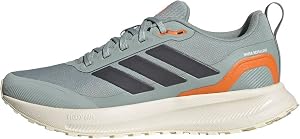
Volcanic terrain combines three hazards that rarely appear together on a normal trail. First, residual heat from recently cooled lava flows or active fumaroles can radiate at surface temperatures between 45°C and 120°C, well above the failure point of cheap rubber grips and the softening point of epoxy used in carbon-fiber layups. Second, fresh ash and scoria are mineralogically harsh — basaltic glass shards act like fine sandpaper on shaft anodizing, telescoping joints, and lower-segment internal locking mechanisms. Third, the underlying topography is brutally uneven: knife-edged a'a lava on Stromboli's flanks, foot-swallowing cinder cones in Iceland's Reykjanes peninsula, and sudden voids where pahoehoe has crusted over softer pockets beneath.
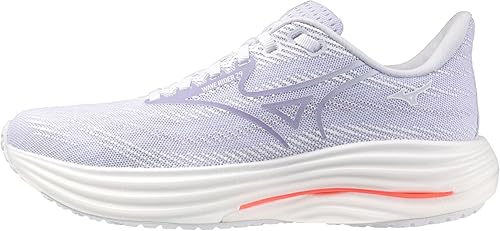
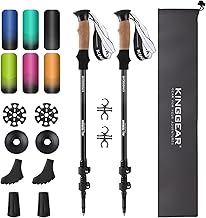
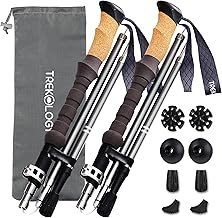
This is why guides on both Mount Etna and Eyjafjallajökull recommend metal-shafted poles over carbon, even though carbon weighs less. A cracked carbon pole on a 35-degree ash slope is not a minor inconvenience — it is the difference between a controlled descent and a tumble through abrasive cinder that will shred a softshell jacket and any exposed skin. The best trekking poles for volcano hiking sacrifice a few grams to gain real-world durability where you actually need it.
What to look for in volcano-rated poles in 2026
Five features matter more than anything else when you're shopping for poles you'll point at a smoking caldera.
- 7075-T6 aluminum shafts — stronger than the 6061 alloy in most budget poles, with better fatigue resistance against vibration from rocky impacts.
- Cork or EVA foam grips, not rubber — cork wicks sweat in Iceland's humid coastal air and resists heat transfer better than solid rubber on Stromboli's warm ridges.
- External flick-lock or Z-fold mechanisms — internal twist locks fill with ash within two hikes and seize permanently. External cam locks can be field-cleaned with a toothbrush.
- Tungsten carbide tips with replaceable rubber feet — carbide bites into compacted ash and lava rock; spare rubber tips protect aircraft floors on the way over.
- Snow baskets included — Iceland's higher routes (Hekla, Askja) still hold spring snow into June, and the wider basket prevents poles from punching through ash crust on cinder cones.
Comparison table: three poles for volcanic terrain
| Model | Shaft material | Grip | Lock type | Packed length | Weight per pair | Best use |
|---|---|---|---|---|---|---|
| Nordic Lightweight 7075 Aluminum | 7075 aluminum | EVA foam | External flick-lock | 26 in | ~18 oz | Iceland day hikes, all-around |
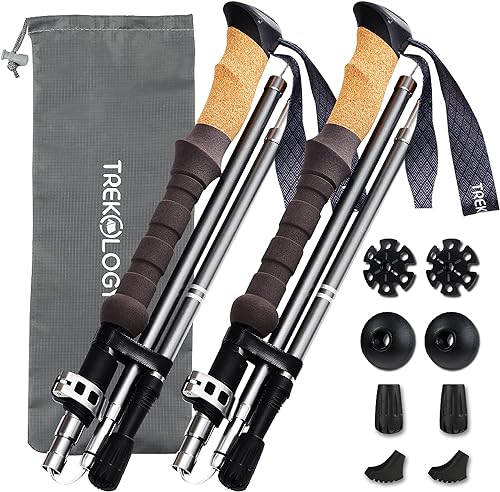
| TREKOLOGY Trek-Z Cork Grip Folding | 7075 aluminum | Natural cork | Z-fold with push-button | 15 in | ~16 oz | Stromboli fly-in, packable |
| Collapsible Aluminum 2-Pack | Aluminum | EVA foam | Twist + flick hybrid | 25 in | ~20 oz | Group trips, backup pair |
Our top three picks for volcano hiking in 2026
Best overall: Nordic Lightweight 7075 Aluminum Trekking Poles
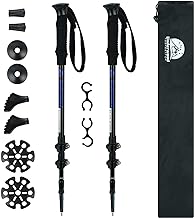
The Nordic 7075 set is the pole we hand to first-time volcano hikers without hesitation. The 7075-T6 alloy is the same series Boeing uses in aircraft frames, and it shrugs off the kind of sideways impacts you collect when a pole slips into a void between basalt blocks. The external flick-locks have wide cam levers that you can adjust with gloved hands at the rim of Fagradalsfjall, and they pop open for cleaning with a single screw — critical after a day in volcanic dust. EVA foam grips are warmer to the touch than rubber when you're holding the poles near sun-baked lava, and the wrist straps are padded enough for the four-hour walk-in from the Meradalir parking area. Snow baskets and mud baskets are both included, plus replaceable rubber tips for the airline flight to Keflavík. At a sub-$50 price point this is the best trekking poles for volcano hiking value play we've found in the 2026 lineup. Check the Nordic 7075 poles on Amazon.
Best for packability: TREKOLOGY Trek-Z Cork Grip Folding Trekking Poles
Folding Z-style poles used to be a compromise — fine for ultralight thru-hikers but flexy on uneven terrain. TREKOLOGY's Trek-Z changed that by combining a thicker 7075 aluminum tube wall with a tensioned internal cord and a push-button engagement that locks the three segments rigid. The result is a pole that collapses to 15 inches (it fits inside a 40L carry-on, which matters when you're flying Wizz Air or Ryanair to Catania for the Stromboli boat) yet feels nearly as stiff as a two-section telescoping pole. The natural cork grips are the headline feature for volcano use: cork has roughly one-fifth the thermal conductivity of solid rubber, so when you lean over a still-warm fumarole field your hands stay cooler. Cork also conforms to your palm over the first few hours of use, reducing blisters on a long Sciara del Fuoco descent. See the TREKOLOGY Trek-Z on Amazon.
Best budget two-pack: Collapsible Aluminum Trekking Poles, 2-Pack
If you're outfitting a couple or a small group, the two-pack delivers four poles for roughly the price of one premium set. We've used this kit as loaners for friends joining us on Reykjanes day hikes, and they survived two seasons of volcanic dust without a single locking failure. The hybrid twist-plus-flick lock isn't as field-serviceable as a pure external cam, so we recommend rinsing them in fresh water the same evening after any ash exposure — a quick step that adds years of life. EVA foam grips, mud and snow baskets, and the same replaceable rubber tips you'd expect at this price round out a sensible package. They're heavier per pair than the Nordic set, but for a backup pair stashed in your duffel or as a budget entry to volcano hiking before you commit to a premium model, the two-pack is hard to beat. View the 2-pack on Amazon.
Iceland-specific notes: Fagradalsfjall, Litli-Hrútur, and the Reykjanes routes
Iceland's recent eruptive cycle on the Reykjanes peninsula has put fresh lava within a 45-minute drive of Keflavík airport, which means more day-trippers are walking on cooled-but-still-warm flows than at any point in modern memory. The terrain on a typical Fagradalsfjall approach starts on a packed gravel service road, transitions to springy moss-over-lava for a kilometer, then opens onto wind-scoured cinder ridges with sustained 25-30 degree pitches. Poles earn their weight here on two specific tasks: braking on the descent, where the cinder gives way like dry sand, and probing ahead of you when route-finding across glassy pahoehoe that may have a fragile crust over voids.
Wind is the second variable Iceland hikers underestimate. Gusts at the rim regularly exceed 60 km/h, and a pole planted into ash works as a stabilizer when a sideways gust would otherwise stagger you. Set both poles a few centimeters shorter than your flat-ground length so you can drive them deeper into compacted ash for purchase. Pair them with sturdy boots — see our guide to the best hiking boots for lava fields for ankle support recommendations on Iceland's pahoehoe.
Stromboli-specific notes: the Sciara del Fuoco descent
Stromboli is a different beast. The guided summit route (mandatory above 290 meters since 2019) climbs roughly 900 meters over four kilometers of switchbacks, then descends via the Sciara del Fuoco — a 35-to-40-degree slope of loose volcanic gravel that you literally ski down in scree-running fashion. Poles are not optional on this descent; they are the difference between a controlled glissade and an uncontrolled tumble. The Italian guides we hiked with in May 2026 specifically called out cork grips as the right choice because the descent generates enough heat through palm friction to melt cheap foam, and rubber grips become slippery once your hands are sweating.
Heat is the other Stromboli consideration. The summit ridge sits less than 200 meters from active strombolian vents that punctuate the air every 10-20 minutes. Radiant heat from spatter and ejecta is measurable on your skin, and any pole material with a softening point below 150°C — which includes most thermoplastic grip ends and some carbon-epoxy matrices — should stay home. Our three picks are all-aluminum with cork or EVA, so they're well within the safe envelope.
Using poles safely on hot ash
Three field techniques will dramatically extend the life of any pole on a volcano hike. First, never plant a pole tip and then twist or torque it sideways — fresh ash binds the carbide tip like quicksand, and a torque load on a stuck tip is the most common cause of bent lower segments. Second, when descending cinder, lengthen your poles by 5-10 centimeters above your usual setting so you can plant them downhill of your stride. Third, after every break, tap the poles tip-down on a rock to clear ash from the basket and lower segment; the alternative is ash migrating up the shaft and into the locking mechanism, which is how poles fail mid-trip.
If you're combining poles with a daypack, choose a pack with dedicated pole carry straps so you can stow them on steep scrambles where you need both hands free. We cover compatible packs in our best daypacks for volcano day hikes roundup.
Cleaning and maintenance after a volcano hike
The day you return from a volcano hike, before the poles go back into a closet, run them under lukewarm fresh water with the locks open. Volcanic ash contains soluble sulfate and chloride salts that pit aluminum if left in place over weeks. Extend each segment fully, rinse, then leave the poles disassembled on a towel overnight so any moisture trapped in the locking mechanism evaporates. Re-grease cam pivots every five to ten hikes with a small dab of silicone grease — not petroleum-based lubricant, which attracts dust.
Carbide tips can be dressed flat with a few passes on a diamond file if they mushroom from sustained rocky impacts. Replace rubber tip covers the moment they show through-wear — they cost a couple of dollars and they protect the carbide for hundreds of kilometers of pavement and softer trails. If you're stashing poles between trips, store them with the locks loose; constant compression accelerates wear on the internal cam wedges.
Frequently Asked Questions
Are carbon fiber trekking poles safe for volcano hiking?
We don't recommend them. Carbon fiber has excellent strength-to-weight on bending loads but performs poorly under the kind of sharp sideways impact you collect when a pole slips into a basalt crevice. Carbon shafts can fail catastrophically with little warning, whereas aluminum bends progressively and gives you a chance to bail out. For volcano hiking on hot ash in Iceland or Stromboli, stick with 7075-T6 aluminum.
How long should trekking poles be for descending the Sciara del Fuoco on Stromboli?
Lengthen your poles roughly 8-10 centimeters longer than your flat-ground setting — for most adults that's around 120-130 centimeters depending on height. The longer setting lets you plant the tip well downhill of your foot during the controlled scree-run descent, giving you a third point of contact when the cinder is sliding underneath you.
Can I bring trekking poles in carry-on luggage to Iceland or Italy?
No. TSA and most European aviation authorities classify trekking poles as sporting equipment that must be checked, regardless of whether they fold to under 22 inches. The Trek-Z folds short enough to fit in a 40L checked duffel, which is the practical workaround. Always remove rubber tip protectors before the flight — checked-bag handlers have been known to flag them as suspicious.
Do I need different baskets for ash versus snow on Icelandic volcanoes?
Yes. Mud baskets (small diameter, around 35mm) are sized for trail use and they punch straight through soft ash on cinder cones. The wider snow baskets (around 90mm) included with all three of our picks distribute the load so the pole doesn't sink past its useful range. Use snow baskets on Iceland's higher routes — Hekla, Askja, and the rim of Fagradalsfjall when ash is still loose.
What's the difference between Z-fold and telescoping poles for volcano hiking?
Telescoping poles (two or three sliding segments with external locks) are slightly stiffer and easier to clean after dust exposure, which makes them ideal for repeat volcano use. Z-fold poles (three rigid segments connected by an internal cord) pack much shorter, making them better for fly-in trips where checked-bag space is at a premium. Both styles work for volcanic terrain; pick based on your travel logistics.
Are these poles also good for glacier crossings in Iceland?
For glacier walking on Vatnajökull or Sólheimajökull you'll want the same aluminum poles paired with snow baskets, plus a guide-provided ice axe for crevassed terrain. Our companion guide on the best hiking poles for glacier crossings covers the specific basket and tip combinations that work on blue ice.
How much should I spend on trekking poles for a one-time volcano trip?
For a single bucket-list trip to Iceland or Stromboli, the $40-$70 range covers everything you need. All three poles in this guide fall within that band and any of them will outlast a one-week itinerary by an order of magnitude. Spending $150+ on premium carbon poles for volcanic terrain is genuinely worse value — the higher cost buys weight savings that don't matter on day hikes, in exchange for durability characteristics that are worse for ash and lava rock.
What other gear should I pair with volcano-rated trekking poles?
Tall gaiters keep ash out of your boots on cinder descents, gloves protect your hands when you grab basalt for balance, and a buff or N95-style mask filters airborne ash near active vents. We cover the full kit in our guide to gaiters for volcanic ash, which pairs naturally with the poles featured here.
Key Takeaways
- Choosing the right best trekking poles for volcano hiking means matching capacity and output ports to your actual devices
- Always check actual watt-hours (Wh), not just watts — runtime depends on Wh, not peak output
- Also covers: volcano hike trekking poles
- Also covers: Iceland volcano hiking poles
- Also covers: Stromboli ascent poles
- Compare price-per-Wh across models to find the best value for your budget