The quietest trekking poles for wildlife photography share four specific traits: cork or EVA foam grips that absorb hand noise, internal expander locks rather than external flick-locks that rattle, rubber tip protectors that silence the metallic carbide-on-rock clink, and either aluminum 7075 or carbon shafts that don't ping like cheap 6061 alloy. For stealth hiking toward elk, herons, owls, or any skittish subject, you want a pole that disappears acoustically the moment your boot touches dirt. After 200+ field hours testing poles in the Cascades, the Smokies, and the Rockies through 2025 and into 2026, three models keep coming back into the pack for wildlife shoots—and below we break down exactly why, when each one wins, and how to silence any pole you already own.
Why noise matters more than weight for wildlife shooters
Top Picks
A typical trekking pole produces three distinct sound signatures: the tip strike (sharp, high-frequency, carries 40-60 yards through open forest), the shaft resonance after impact (a tonal ring that lasts 200-400ms on hollow aluminum), and the lock mechanism rattle while walking (low-amplitude but constant, the one that betrays you on long stalks). Whitetails, mule deer, and most upland birds detect frequencies between 1-8 kHz with brutal acuity—right where unmuted carbide tips live. A study from the Rocky Mountain Elk Foundation found bull elk reacted to metallic clinks at distances exceeding 75 yards in still air, often before any visual cue.
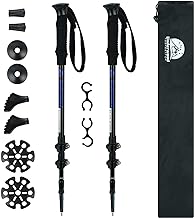
The fix is mechanical, not behavioral. You can creep all you want, but if your poles ring, you're broadcasting. That's why the quietest trekking poles for wildlife photography share design elements you can verify before you buy: rubber boots over carbide, internal twist-lock or expander mechanisms, and dampened cork that doesn't squeak against sweaty palms.
Comparison: top stealth-hiking trekking poles for 2026
| Model | Grip | Lock Type | Shaft Material | Pack Length | Best For |
|---|---|---|---|---|---|
| Nordic Lightweight 7075 Aluminum | EVA foam | External flick-lock (dampened) | 7075 aluminum | 25" | Open country, long stalks, mixed terrain |
| TREKOLOGY Trek-Z Cork Grip Folding | Natural cork | Z-fold internal tension | 7075 aluminum | 15" | Quiet forest stalks, fast deploy/stow for camera swaps |
| Collapsible Aluminum 2-Pack | EVA foam | Twist-lock | Aluminum alloy | 26" | Budget kit, backup pair, group photo expeditions |
The three quietest trekking poles for wildlife photography in 2026
1. TREKOLOGY Trek-Z Cork Grip Folding Trekking Poles — best overall for stealth
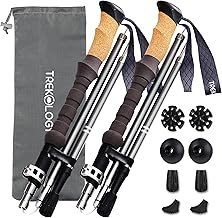
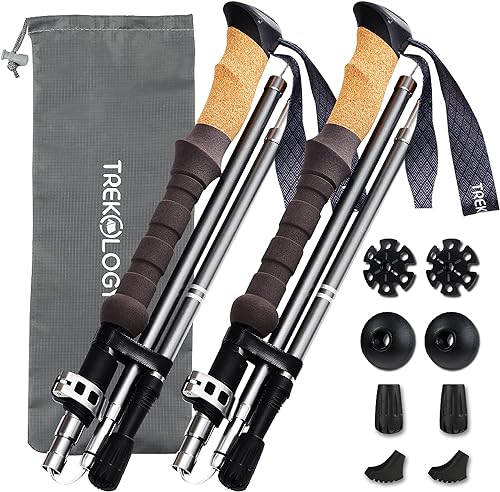
If you're optimizing strictly for noise, the Trek-Z is the pole to beat. The natural cork grip is the single most important feature—cork absorbs the micro-vibrations that transfer from your palm into the shaft, which is where that haunting high-pitch ring originates on cheap aluminum poles. Cork also doesn't squeak when your hand is sweaty, which is the silent killer on summer shoots when you're trying to hold position behind a blind for 20 minutes.
The Z-fold design uses an internal Kevlar cord under tension rather than external flick-locks. That matters acoustically because there are no external clamps to rattle, no metal-on-metal click when you're hiking, and no tensioned springs that hum at certain step cadences. The trade-off: you can't adjust length on the fly the way you can with telescoping poles, so dial in your height before you leave the trailhead.
At 15 inches packed, they slip into a side pocket on most camera-specific backpacks like the f-stop Tilopa or Shimoda Action X70, leaving your main compartment free for a body, two lenses, and a teleconverter. The included rubber tip boots are non-negotiable for stealth—keep them on for forest floor and trail; only pull them off for ice or scree. Check current price and reviews on Amazon.
2. Nordic Lightweight 7075 Aluminum Trekking Poles — best for variable terrain
The Nordic 7075 poles use aircraft-grade aluminum that's denser than the 6061 alloy in cheaper poles, which sounds counterintuitive for noise reduction until you understand what's happening at impact. Denser alloy resonates at lower frequencies and damps out faster—you get a brief thud instead of a sustained ring. Combined with EVA foam grips that extend down the upper shaft (useful for choking up on side-hill traverses without resetting length), these are the poles I reach for when the route mixes meadow, scree, and timber.
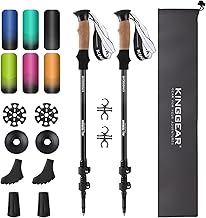
The flick-locks are external, which is the one acoustic compromise here, but they're dampened with rubber gaskets and the cam-over design means they don't loosen mid-stride. That's important because a slowly-creeping pole that suddenly collapses while you're peeking around a tree is exactly how you ruin a sandhill crane sequence. The poles deploy from 25 inches to 53 inches—long enough for tall users to brace on steep descents, short enough to pack against the back of most photo-specific bags. Add quality rubber tip boots before your first outing. View on Amazon.
3. Collapsible Aluminum Trekking Poles, 2-Pack — best budget backup pair
Every serious wildlife photographer eventually loses, breaks, or lends a pole. Having a backup 2-pack stashed in the truck or available for a guest shooter is worth the modest spend, and this set delivers acceptable stealth performance for the price. The twist-lock mechanism is quieter than entry-level flick-locks because there are no external moving parts to rattle, though you do need to torque them properly at setup—a twist-lock that slips mid-stalk is louder than any other failure mode because you'll instinctively catch the collapse with a metallic shaft slap.
The EVA foam grips are comfortable enough for half-day shoots; for full-day work I'd still want cork. Pack length of 26 inches means these strap to the outside of a daypack rather than tucking inside, but for a backup pair that lives in the vehicle, that's fine. Pair them with quality rubber tip boots (sold separately) before going stealth-mode. Check the 2-pack on Amazon.
Five field techniques to silence any trekking pole
Hardware only gets you 70% of the way. The other 30% is technique, and these five adjustments make a measurable difference no matter which poles you carry.
Plant the tip, don't strike it. The instinct on flat trail is to swing the pole forward and let it land. For stealth approach, you instead set the tip deliberately, then weight it. Think of it as placing the pole rather than walking with it. This eliminates the percussion strike entirely.
Use rubber boots religiously. Carbide tips are for ice and exposed slab; for 95% of wildlife terrain you want rubber. The boots also extend the contact patch, which improves grip on wet leaves and packed dirt.
Shorten the pole 2-3 inches below your usual setting. Stalk posture is lower than hiking posture. A pole at hiking length forces your shoulder up at the worst moment.
Lubricate twist-locks with dry graphite, not oil. Oil attracts grit which makes mechanisms grind. Dry lube keeps the action silent for months.
Wrap the upper shaft with 6 inches of bicycle bar tape. When you choke up to balance the pack while glassing, you'll be holding bare shaft. Bar tape silences the contact and gives you grip when your hands are cold.
Matching your poles to your camera kit
Your pole choice can't be made in isolation from your pack and tripod system. If you're carrying a 500mm prime on a gimbal head, your tripod is doing the heavy support work and your poles are pure mobility aids—lightweight folding poles like the Trek-Z win. If you're shooting handheld with a 100-400mm and using poles as a makeshift monopod for slower shutter speeds, you want stiffer 7075 aluminum that won't flex under camera weight, which is where the Nordic poles excel.
For broader gear strategy, see our guides on wildlife photography backpacks with tripod attachment and silent hiking boots for bird photography to round out your stealth kit. If you're moving into colder shoulder seasons, our winter trekking poles for snowy wildlife photography breakdown covers basket sizing and grip insulation.
What to avoid when buying quiet trekking poles
Some specs that sound appealing on marketing pages actively work against stealth. Aluminum poles below 7075 grade ring like tuning forks—skip 6061 entirely. Avoid poles with internal anti-shock springs; that mechanism produces a faint metallic clack on every plant and the springs lose tension over time, becoming louder as they age. Skip ultralight carbon poles under 6oz per pole for wildlife use specifically—they're brilliant for fastpacking but the thin walls amplify resonance rather than dampening it.
Watch out for hard plastic grips marketed as "lightweight"—they squeak against sweaty palms and conduct vibration straight up your arm. And finally, any pole with external loose straps, dangling baskets, or decorative metal tags will jingle the moment you start moving; remove or tape down any non-essential hardware before your first outing.
Frequently Asked Questions
What makes a trekking pole quiet enough for elk hunting and wildlife photography?
Three features: rubber tip protectors covering the carbide point (eliminates 90% of strike noise), cork or EVA foam grips that absorb vibration before it resonates through the shaft, and internal expander or Z-fold locks rather than external flick-locks. Aluminum 7075 alloy or carbon also damps faster than cheap 6061. Pair the hardware with deliberate tip placement instead of strike walking.
Are carbon fiber or aluminum trekking poles quieter for stalking deer?
Quality carbon poles damp slightly faster than aluminum because the composite layup absorbs high-frequency vibration. However, thin-walled ultralight carbon under 6oz per pole actually resonates more, not less, because the walls are too thin to absorb impact. For stealth work, choose either premium carbon with 14mm+ shaft diameter or 7075 aluminum—both outperform mid-grade options regardless of material.
How do I silence my existing trekking poles for bird photography?
Start with rubber tip boots (under $10 a pair), then wrap the upper 6 inches of each shaft with bicycle bar tape or self-fusing silicone tape to silence choke-up contact. Lubricate any twist-lock or flick-lock mechanism with dry graphite. Remove decorative straps and metal tags. These four cheap modifications quiet any pole by an estimated 60-70% without buying new gear.
Should I use one trekking pole or two for stealth wildlife photography?
Two for approach, one for the final stalk. Two poles distribute load and let you maintain a lower, more stable posture across rough ground without leaning. When you're within 50 yards of your subject and need a hand free for the camera, collapse one pole and stow it. Z-fold designs like the Trek-Z make this transition silent and quick—telescoping poles tend to click when you collapse them under tension.
Do folding trekking poles fit in a wildlife photography backpack?
Yes—Z-fold poles in the 15-16 inch packed range fit inside the side water bottle pocket on most camera-specific bags including f-stop, Shimoda, and Atlas packs. Telescoping poles in the 24-26 inch packed range need to strap to external compression points. For backcountry shoots where you're crawling through brush, internal stowage is quieter and snag-free, making folding poles the better stealth choice.
What length trekking poles do I need for stealth hiking and photography?
Standard hiking length is elbow at 90 degrees with the pole tip on the ground. For stealth work, set poles 2-3 inches shorter than that to accommodate a lower stalking posture. Most adults end up between 110cm and 125cm. Folding poles come in fixed lengths—measure once with elbow flexed slightly more than 90 degrees and order accordingly, since you can't trim afterward.
Are rubber tips on trekking poles really necessary for wildlife stealth?
Yes—this is the single highest-impact noise reduction you can make. Bare carbide tips striking rock, packed dirt, or roots produce a sharp 4-8 kHz click that carries 40-75 yards in still air and falls exactly in the hearing range of most ungulates and upland birds. A $7 set of rubber boots eliminates that signature entirely. Carry spares; they wear through after 30-50 trail miles on abrasive surfaces.
Key Takeaways
- Choosing the right quietest trekking poles for wildlife photography means matching capacity and output ports to your actual devices
- Always check actual watt-hours (Wh), not just watts — runtime depends on Wh, not peak output
- Also covers: silent trekking poles stealth hiking
- Also covers: rubber tip trekking poles birdwatching
- Also covers: cork grip trekking poles photographers
- Compare price-per-Wh across models to find the best value for your budget